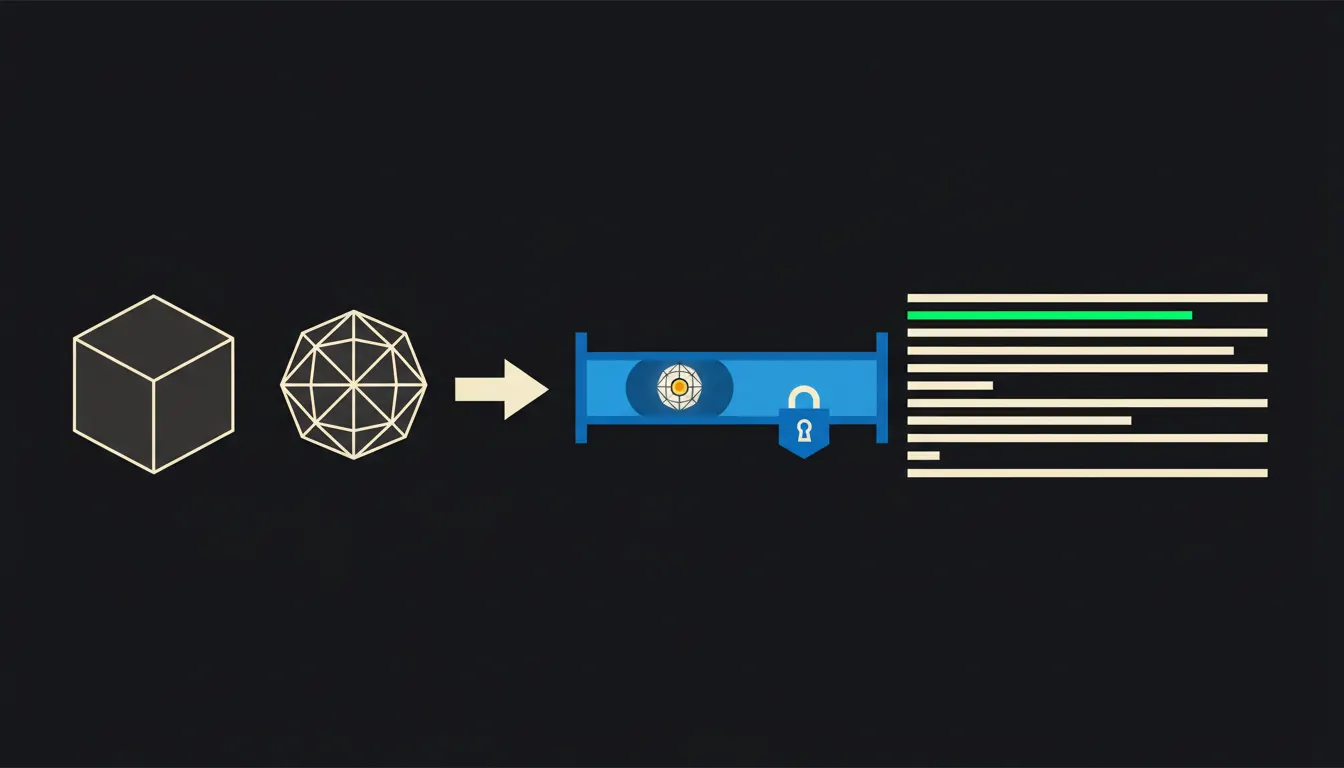
Search for "MCP server Blender" today and you will find clips where Claude builds a 3D scene from one sentence: it adds objects, changes a material, moves the camera. It looks like a toy for graphics people. The interesting part is the pattern underneath, because the same pattern can serve your warehouse, your accounting system or your e-shop.
Why Blender became the example everyone searches for
Blender is an open-source 3D program with a long-established scripting interface. Someone wrote a small add-on for it and put an MCP server next to that. Claude was handed a list of actions it was allowed to call, and it started calling them. The result is visible instantly: a cube moves, a material turns green, the camera swings around.
That visibility is what made Blender the textbook case. Connecting an accounting system looks like nothing on video, because one line in a list of documents changes. Connecting a 3D scene looks like a trick. Technically it is almost the same work, and that is the part an ordinary company should take away.
If MCP can drive a graphics program, it can drive a warehouse just as well. The difference is that a warehouse has consequences.
— A meeting note, abridged
What an MCP server actually is, without the jargon
MCP (Model Context Protocol) is an open standard Anthropic published at the end of 2024. It describes how an AI application and an outside program shake hands: how they tell each other what they can do, and how a request and an answer get passed across. Without it, every connection was written separately and differently every time.
An MCP server is a small program that sits next to a system you already have. It offers a short, readable list of actions: check stock for this item, find this document, create a draft order. Claude sees the list, picks one and calls it. The server does the work and returns the result. It is a well-labelled remote control for your system rather than intelligence in itself.
Concretely: a warehouse, Pohoda or an e-shop instead of a 3D scene
A company that keeps its books in Pohoda, its orders in an e-shop and its contacts in a simple CRM does not have to change any of it. Those systems stay where they are and keep doing what they did. What gets added is a thin layer that opens them to Claude at exactly the scope a given person already has. For one system that is usually days of work, not months.
- Reads stock for an item code and answers in a sentence, not as an export into a spreadsheet.
- Finds overdue documents in accounting for the customers a given salesperson looks after.
- Creates a draft order or delivery note and leaves it waiting for approval.
- Locates the latest version of a contract on the company drive and attaches it to the answer.
- Writes an agreed date onto the right contact in the CRM.
Picture a three-person company with an e-shop: the owner, one person on dispatch, one external bookkeeper. Every morning they query three windows and retype the answers into a fourth. With one bridge to the e-shop and one to accounting, they ask once and get an answer already put together. Treat this as an illustration, not a measured case. The shape of the saving is always the same in small companies: the retyping disappears.
What an MCP server will not do, and why that is good
It gains no rights the person at the keyboard does not have. If a bookkeeper cannot see payroll, neither can Claude when it asks on her behalf. The server needs no back door, because every route in goes through permissions you already maintain.
And it will not decide for you. Pricing, exceptions, credit notes and cancellations are still approved by a person. That limit is not a weakness, it is the reason such a bridge can be allowed near live data at all. A system that can only prepare a draft can be deployed sooner and more widely than one that can confirm a payment.
What it would take
You start by picking the one system where the retyping hurts most. One MCP server gets built next to it, with a short list of actions and a link to your own sign-in. It runs on your side, in one environment, with an audit trail. Once it holds, a second system follows. A routine the team invents and wants to repeat goes into the skills library, so everyone can run it the next morning, each with their own rights.
What is left
Blender works as a demo precisely because it looks pointless. It shows that the model can drive an outside program reliably the moment it gets a clear list of actions and access under the right identity. So the model is not the bottleneck. The bottleneck is the distance between it and the data your company has had for years.
Write to us. On a short call we will pick one system, walk through who is allowed to see what inside it, and tell you plainly what the first bridge would involve and what it would not.