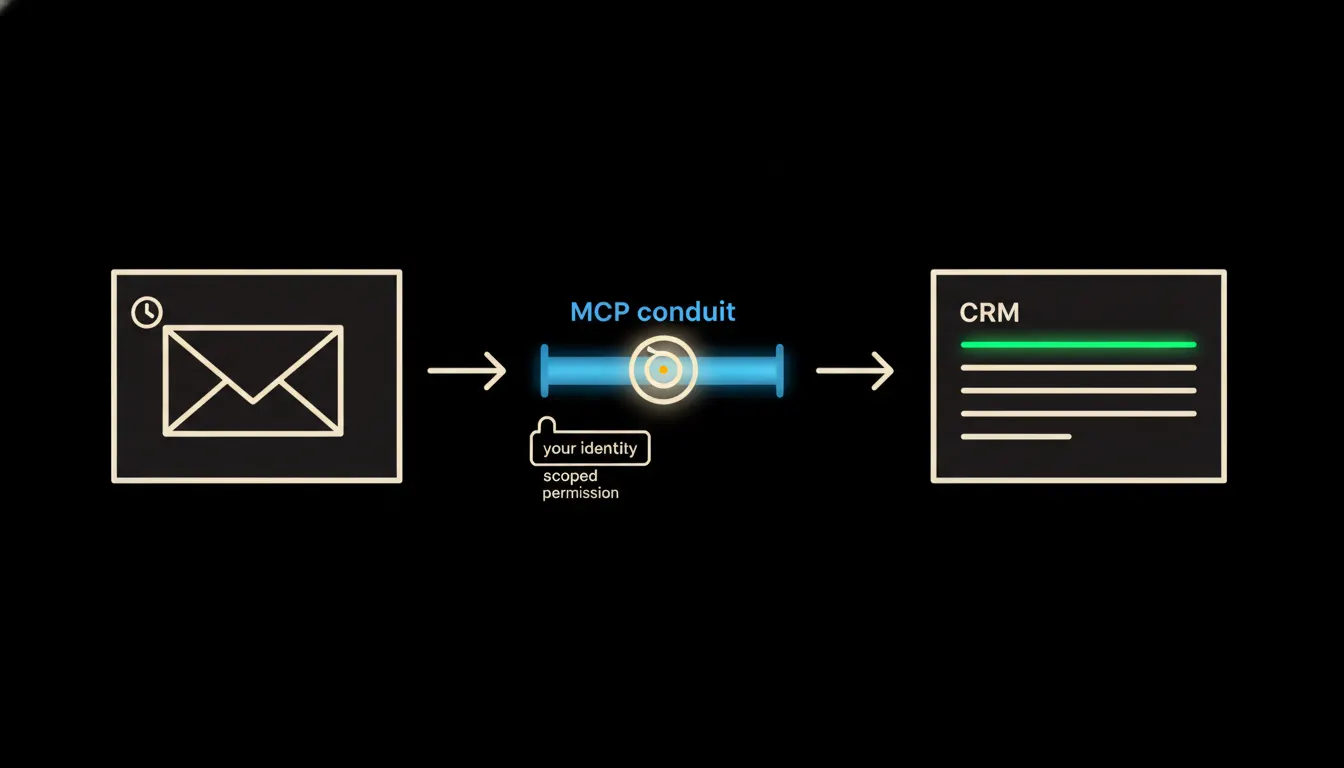
A customer sends an enquiry Friday at 2:43 pm. The sales rep reads it, plans to reply, but has a meeting first. Monday morning brings a short message: "Thanks — we went with another supplier who got back to us straight away." The deal wasn't lost on price. Or quality. It was lost on who showed up first.
The work nobody actually wants to do
A good reply to an enquiry isn't short. It has to show you read the enquiry. That you know who the customer is. That you're ready. So the rep opens the CRM, finds the account, scans the activity history, checks for open deals, then returns to the email and starts writing. The whole ritual takes thirty minutes — if things go smoothly.
And that assumes the rep is actually at their desk. In practice, enquiries arrive in the evening, at weekends, over lunch. An automated "we received your message" reply reads, today, as a signal that nobody was paying attention. Research shows the average first-response time at B2B companies exceeds 42 hours — and most customers have made their decision long before that.
It came in Friday at 14:43. Monday morning it was the first thing we opened. The customer had unfollowed us on LinkedIn over the weekend.
— A scene from an ordinary Monday morning in a sales department
What this actually means: Claude + CRM via MCP
AI stack connects Claude to a company's CRM through a small MCP server. When an enquiry arrives — by email, web form, or CRM ticket — Claude reads it and simultaneously pulls from the CRM everything that exists for that customer: conversation history, previous orders, the assigned rep's name, any open opportunities. Then it assembles a draft reply.
The MCP server doesn't operate as blanket access to the entire database. It fetches exactly the data the signed-in rep is permitted to see. If rep Novák doesn't have access to customer Dvořák's account, Claude won't see it either. Identity travels through the entire flow — from the incoming enquiry through context retrieval to draft assembly.
Concretely: Raynet or Pipedrive
The two most common CRM platforms at smaller Czech companies are Raynet (a Czech product, popular with service and B2B firms) and Pipedrive (international, but widely adopted in the Czech market). Both have APIs through which an MCP server can read account cards, communication history, and deal status. Illustratively: a four-person sales team handling around twenty enquiries a week — each reply taking twenty to thirty minutes of prep — would reduce that prep to reading and approving a draft.
- An enquiry lands in the CRM or inbox — Claude reads it and identifies the customer.
- The MCP server loads the customer's CRM card: history, assigned rep, open deals.
- Claude assembles a reply draft in the tone and structure the team uses (learned from templates in the skills library).
- The rep receives the draft for review — edits what they want, sends it under their own name.
- The CRM updates automatically: new activity logged, timestamp set, opportunity status refreshed.
An illustrative example: a freelancer or small agency receives a website enquiry on Sunday evening. Instead of the customer waiting until Tuesday, they receive a reply Monday morning — before the first meeting of the day — with links to relevant projects, a brief outline of the process, and a suggested slot for an introductory call. The rep sent it in three minutes, because they didn't have to write it from scratch.
What AI enquiry response will not do — and why that's fine
Claude does not send the reply itself. It does not set the price or agree the terms. It does not know whether you want this customer — that's the rep's call, because they know the market, the relationship history, and the team's current capacity. The draft is always a draft: text to read, adjust, and approve.
This boundary is not a technical limitation. It is a deliberate design choice. An automated reply sent without a human reading it is recognisable — and customers notice. The value is that the rep gets a solid foundation in a fraction of the time and responds quickly with a thoughtful, contextual message. Speed plus human judgement — not one at the expense of the other.
What it takes
The MCP server for your CRM is set up once. It runs on your own infrastructure — not on AI stack's cloud, not in any shared environment. Customer data never leaves your system and is never copied into a third-party cache. The audit trail logs every query: who asked, what for, when.
What's left
The model is not the bottleneck. Claude can draft a solid reply to an enquiry before you finish your first sentence. The bottleneck is the gap between Claude and the data your company already holds — the CRM history, the reply templates, the knowledge of the customer. That gap is what we close.
If your team replies to enquiries late not because they're slow, but because preparing each reply takes thirty minutes — write to us. A short call, no lengthy project commitment to start. We'll show you what it looks like with your own data.