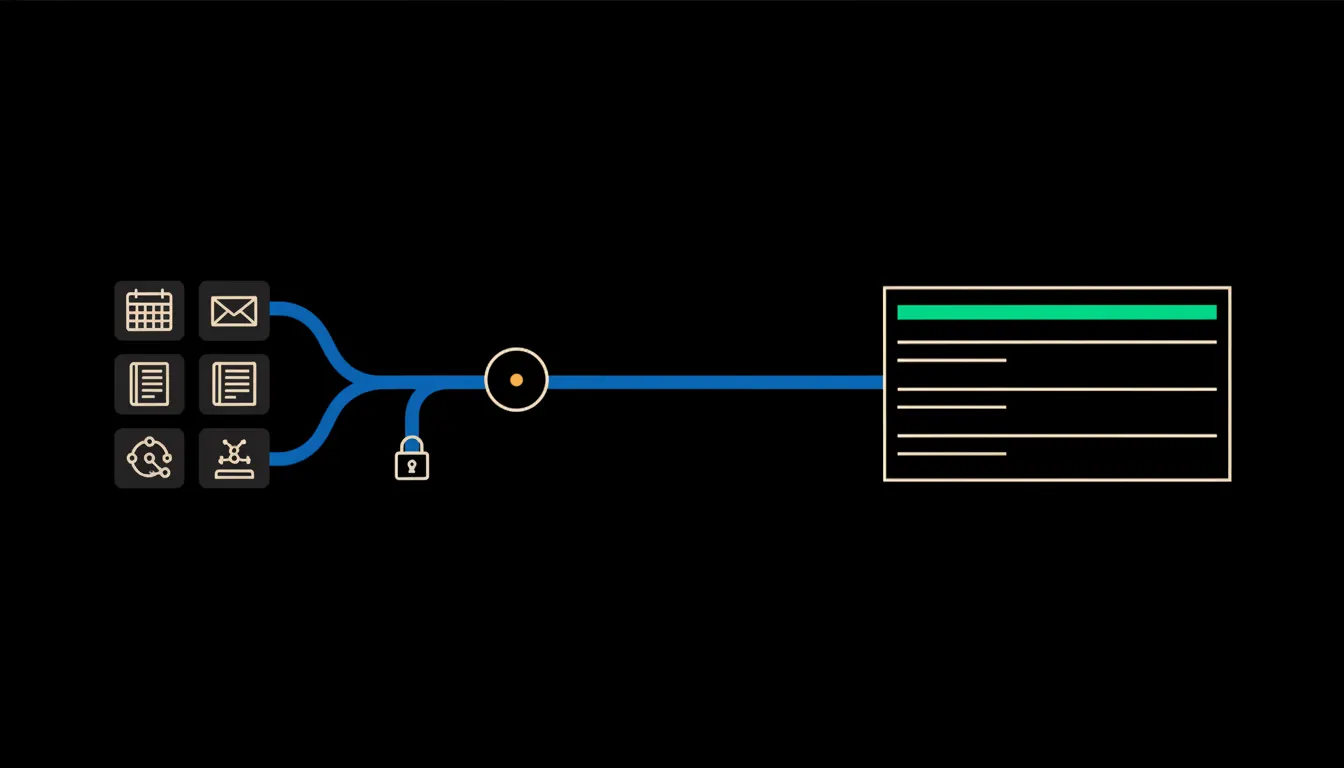
When someone goes looking for an AI personal assistant, they usually want one specific thing: to know in the morning what the day holds, without assembling it from five open windows. A general assistant will answer that with a nicely written sentence and no knowledge of your company. Whether it saves you an hour a day comes down to one thing: what it is connected to.
The work nobody wants
Monday, quarter to eight. The CEO of a forty-person company has six meetings before the evening. Ahead of each one he needs roughly five facts: who he is meeting, what was last agreed, what the deal is worth, whether it has been paid, and what nobody has delivered yet. None of it is hard. All of it lives somewhere else.
The time is in the calendar. The last agreement is in an email thread from last month. The price is in a proposal on the shared drive, in a version you are not sure is the final one. The balance is in the accounting system the bookkeeper logs into. The note that the client sounded irritated last time is not written down anywhere; the salesperson is carrying it in his head. Assembling all of this takes forty minutes, and nobody records it as work.
Forty minutes of searching, two minutes of deciding.
— A Monday morning, abridged
What an assistant that knows your company actually means
The model is not the constraint. Claude can read a contract, compare numbers and write a decent summary. It just does not know your data, because there is no path to it. We build that path. It is called MCP, an open protocol from Anthropic, and in practice it is a small server that exposes one specific system: the calendar, the mail, the CRM, the accounting ledger.
What matters is what travels across that bridge. Not blanket access, but your own login. When you ask, the assistant sees what you see. When a salesperson asks, they see their own deals and nothing more. The data stays where it lives. Nothing is copied into an index, nothing lands in a vendor cache, the bridge reads at the moment of the question and holds nothing afterwards.
Concretely: a Monday brief out of Pohoda, mail and the calendar
Nothing changes. Accounting stays in Pohoda or Fakturoid, mail and calendar stay where they are today, proposals stay on the drive, contacts stay in the CRM or in a spreadsheet, because in a forty-person Czech company it is usually a spreadsheet. All that gets added is the bridge and one instruction you write once: this is what my morning overview looks like.
- It walks through today's calendar and pulls the most recent email exchange with each person you are meeting.
- It adds invoice status from accounting: what is overdue, what is issued, what the customer has spent in total.
- It fills in deal stage and last contact date from the CRM or the spreadsheet.
- It flags what is missing: an unsigned contract, an unsent proposal, a question older than three days with no answer.
- It returns one page, ordered by where a delay or a payment is at risk.
Say a manufacturer in the Vysočina region, forty people, with the CEO also running sales. Today a colleague prepares the notes and loses an hour to it every morning. With the bridge in place, Claude does the same assembly in two minutes and the colleague reviews the brief and adds the context no system holds. The example is illustrative; the stack of systems is not unusual.
What an AI assistant will not do, and why that is good
It will not decide who you call first. It will not write to an unhappy client on its own initiative. It will not move a supplier payment, even when the numbers suggest it. It will not sign a proposal. It prepares the brief, marks what looks uncertain, and stops.
That boundary is not caution, it is the reason the assistant survives inside a company. A tool that sends on its own gets switched off after the first awkward message to a client and never comes back. A tool that assembles and leaves the signature to a person keeps getting used. A Harvard Business Review study of how CEOs spend their days found that the overwhelming majority of their time goes to meetings and communication. An assistant will not change that ratio, but it can return the part you spend hunting for context beforehand. McKinsey has estimated that reading and writing mail alone takes up around a quarter of the knowledge worker week.
What it would take
You start with one system, usually calendar and mail, because that is where the difference shows fastest. Accounting and CRM follow. The bridge runs on your infrastructure, in your tenant, with your audit trail. It is not a year-long project and not a migration. A first version of the morning brief is usually a matter of days, and you know immediately whether it fits you.
What is left
The model is not the bottleneck. The bottleneck is the gap between Claude and the data your company already has. That gap is why most people try an assistant, get a pleasant generic answer, and a week later use it only to rephrase emails. Close the gap and the assistant stops being a toy and starts writing the one page you actually read in the morning.
If you want to see what your morning brief would look like, write to us. A short call is enough to go through what sits in your calendar, your mail and your accounting, and to say which bridge is worth building first.