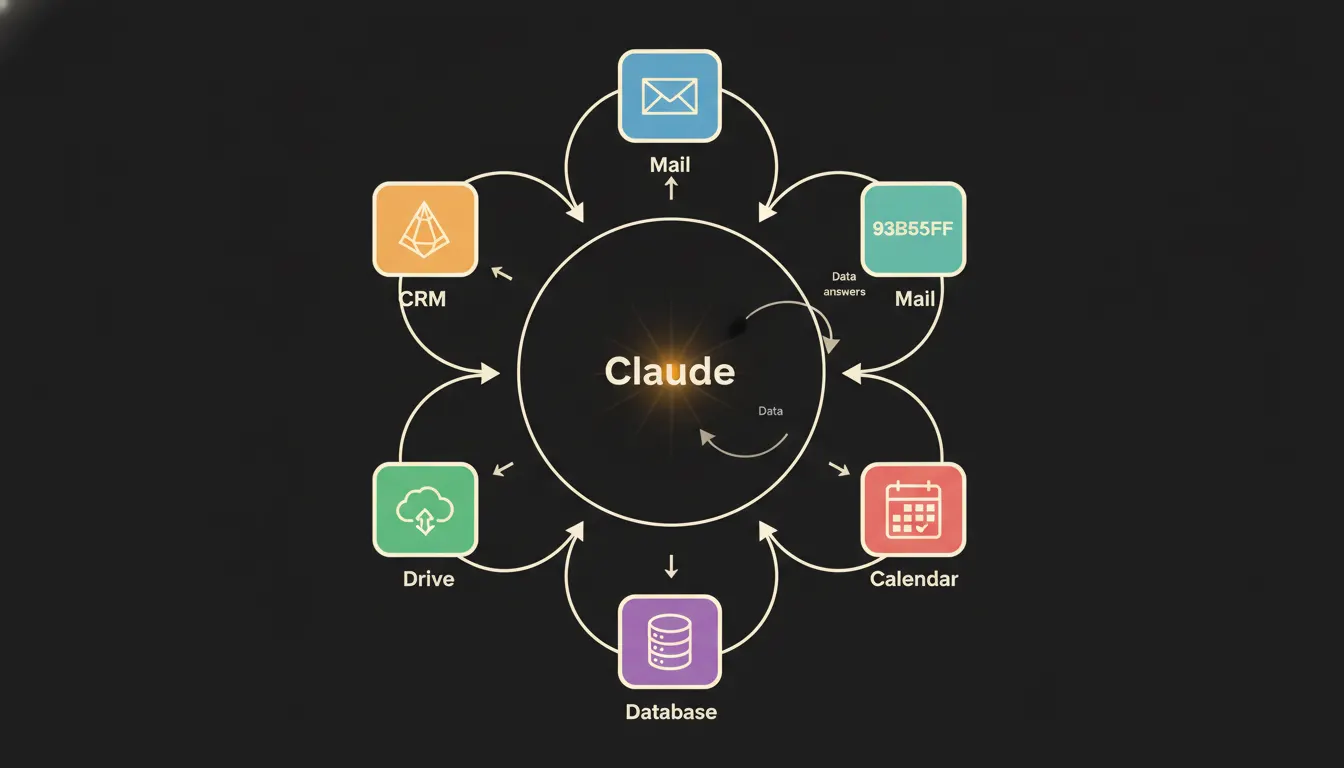
Watching a demo of Claude is one thing. Watching it suddenly know the name of your biggest customer, what they bought last quarter, and when they renew: that is when the meeting stops being a demo and starts being a decision. The difference is connected data.
An AI without your data is just a clever chat
Most people first meet Claude inside a chat window. Type something, get a polished answer, feel impressed, close the tab, go back to work. That moment is fine, but it is not why anyone hires us.
The version that actually changes how a company runs is the one that knows your customers by name. That can open the right document without being told where it lives. That can see today's meeting and prep you for it. The intelligence is the same. What is different is what it can reach.
A great model with no data is a tutor. A good model with your data is a teammate.
What "connected" actually means
When we say Claude is connected to your data, we mean something specific: there is a small piece of software (an MCP server) running in your infrastructure, that knows how to ask one of your tools a question, in your user's name, and bring the answer back. One server per tool. One identity per request. Nothing copied, nothing indexed, nothing sitting in a vendor's cache.
That last part matters. The data lives where it lives: in your CRM, in your inbox, in your books. Claude does not get a copy of all of it. It asks a question, gets just what it needs, uses it for that conversation, and forgets it.
The first connection that pays for the whole project
If we can only build one MCP server for a company, it is almost always the one that talks to the CRM. The CRM is where the world of "what the company does for money" lives: accounts, deals, contacts, notes from every call, renewal dates, ownership. Connect Claude to that, and four or five things suddenly become possible the same week.
- "Brief me on Acme for my 3 pm call" and the answer is the latest deal stage, who is in the room, and what last quarter looked like.
- "Which accounts are renewing in the next 60 days?" And the answer is real, not from a stale spreadsheet.
- "What changed on the Acme account this week?" And the answer is the actual notes, summarised, with the small detail that matters at the top.
- "Draft a follow-up to the call I just had with Acme" and the draft is in your voice, with the right context, ready to send.
None of these are exotic. They are the things every salesperson, every account manager, every founder does many times a week. Connecting the CRM is what makes those things take five minutes instead of forty.
Then the connections compound
The CRM connection is the loudest win, but the quiet ones are what makes Claude feel like a real teammate. Once we add the next two or three connections, the conversations stop feeling like requests and start feeling like working with someone who already knows what is going on.
- Calendar: so Claude can see today's meetings and prep you before each one without you asking.
- Mail: so it can pick up on the thread you have been having with a customer and continue it, not start a new one.
- Files: so you can ask "what did we agree on with this client in March" and get back the actual paragraph from the actual document.
- Support: so customer-facing teams can see, in their own workflow, whether a customer is happy this week or quietly furious.
The first day was novelty. The second week was when people stopped asking whether they would lose their jobs and started asking whether we could do another one of these.
— What customers tell us
The pattern: go deep, not wide
It is tempting to try to connect everything at once. We have learned not to. The companies that get the most out of this go deep into two or three systems before they touch a fourth. Pick the one where the work piles up most (usually the CRM, sometimes support, occasionally a custom internal database), and make those interactions feel inevitable. Then add the next.
The boring conclusion underneath all of this: the model is not the bottleneck. Claude is already extraordinary. The bottleneck is everything between the model and the thing your company already knows. Build that part well, respect the rules your data already lives by, and the AI you already pay for becomes worth ten times what it costs.