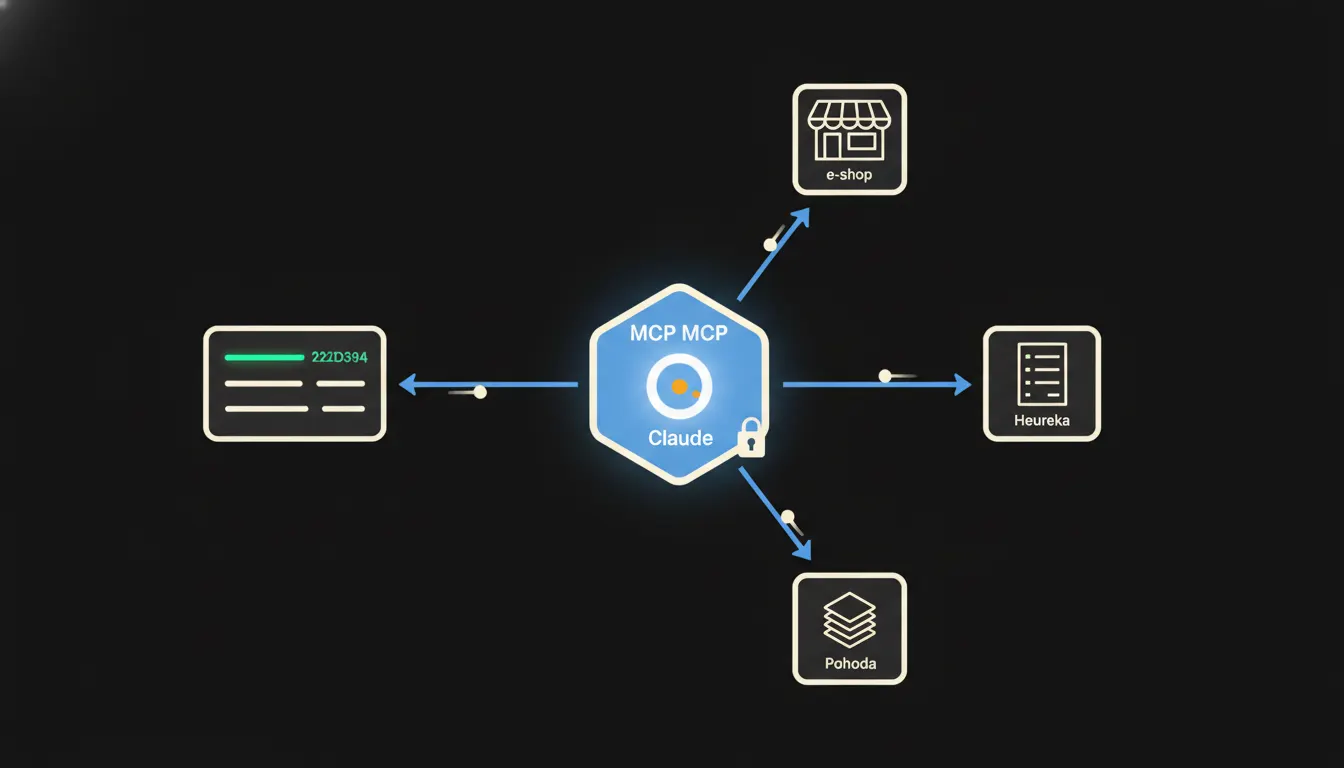
You switched suppliers, and with that came a new package weight, a different EAN, and a revised warranty. You know what that means: open Shoptet, Pohoda, the Heureka spreadsheet, and the wholesale portal, and type the same thing four times. It takes ninety minutes. Then a customer emails because they bought the product based on the old spec.
The work nobody wants
A product card is the basic unit of truth for an e-shop. But that truth lives at four addresses simultaneously: the store admin, the warehouse system, the XML feed for price-comparison sites, and the materials used by sales reps or ad campaigns. Each address has its own login, its own fields, its own format.
A small e-shop changes dozens of items every month: seasonal prices, new variants, updated certificates. The owner, or the one person in the warehouse, does it manually, one card at a time. The work is not complicated, but it reliably takes the afternoon.
I changed the price in the warehouse system. A week later I still had the old price in the store. A customer paid less than we intended, and I had no good way to explain that without looking unprofessional.
— Owner of a sporting goods e-shop, illustrative example
What "connected" actually means
AI stack builds small MCP servers: one for each system you work with. The server does not log in on its own behalf. It carries your identity: your credentials, your permissions, your access scope. Claude, through these servers, sees only what you would see if you logged in yourself.
When you update a product card in the authoritative source (say, Pohoda or an internal document), Claude reads the change and pushes the update through the relevant MCP servers to Shoptet, to the Heureka feed, and to any other connected system. No data copied between platforms. No export to a spreadsheet. The change travels directly, with the right permissions.
Concretely: Shoptet + Pohoda + Heureka feed
Shoptet powers more than thirty thousand Czech and Slovak online stores (Shoptet, 2024). The vast majority of mid-size operators run Pohoda alongside it for accounting and inventory, plus an XML feed for Heureka or Zboží.cz. Three systems, three logins, three sets of fields. And a single spec change has to pass through all three.
- Claude reads the updated card from Pohoda (name, EAN, weight, price, availability, warranty).
- Through the Shoptet MCP server, it updates the relevant product variant: name, parameters, price, stock status.
- Through the XML export MCP server, it generates an updated row for Heureka and Zboží.cz and pushes the feed.
- Optionally: it updates product data in Google Merchant Center or a shared document used by the sales team.
- It produces a summary: what changed, where, at what time, for your review before confirmation.
Consider an illustrative example: an electronics e-shop operator with 400 active SKUs changes prices or parameters on 30–50 of them each month. Today one person handles this manually, averaging around fifteen minutes per item across all channels. With the bridge in place, the manual effort shrinks to reviewing the output: minutes, not hours.
What AI product updates will not do and why that is good
The bridge does not decide whether the price should be €52 or €62. It does not evaluate whether the new supplier spec is correct. It does not write marketing copy or create product cards from scratch. These are tasks that require judgement, and judgement stays with you.
This limit is deliberate. The bridge is fast and accurate precisely because it has a clearly bounded role: carry decisions you have already made to the systems that need to know them. You see the output before it is sent. You confirm the change.
What it would take
We need to know which systems you run and where your authoritative product data lives. From that we design a set of MCP servers: typically three or four, one per connected system. The infrastructure runs on your cloud or server, not ours. Your credentials do not leave your perimeter.
What remains
The model is not the bottleneck. Anthropic Claude can read a product card and format the output for five different systems without hesitation. The bottleneck is the gap between the model and the systems your company actually runs: Shoptet, Pohoda, the Heureka feed. That gap is what we close.
Write to us. A short call is enough to map which systems you have, where your product data lives, and what a bridge would look like in practice. No year-long implementation project, just connecting what you already run.