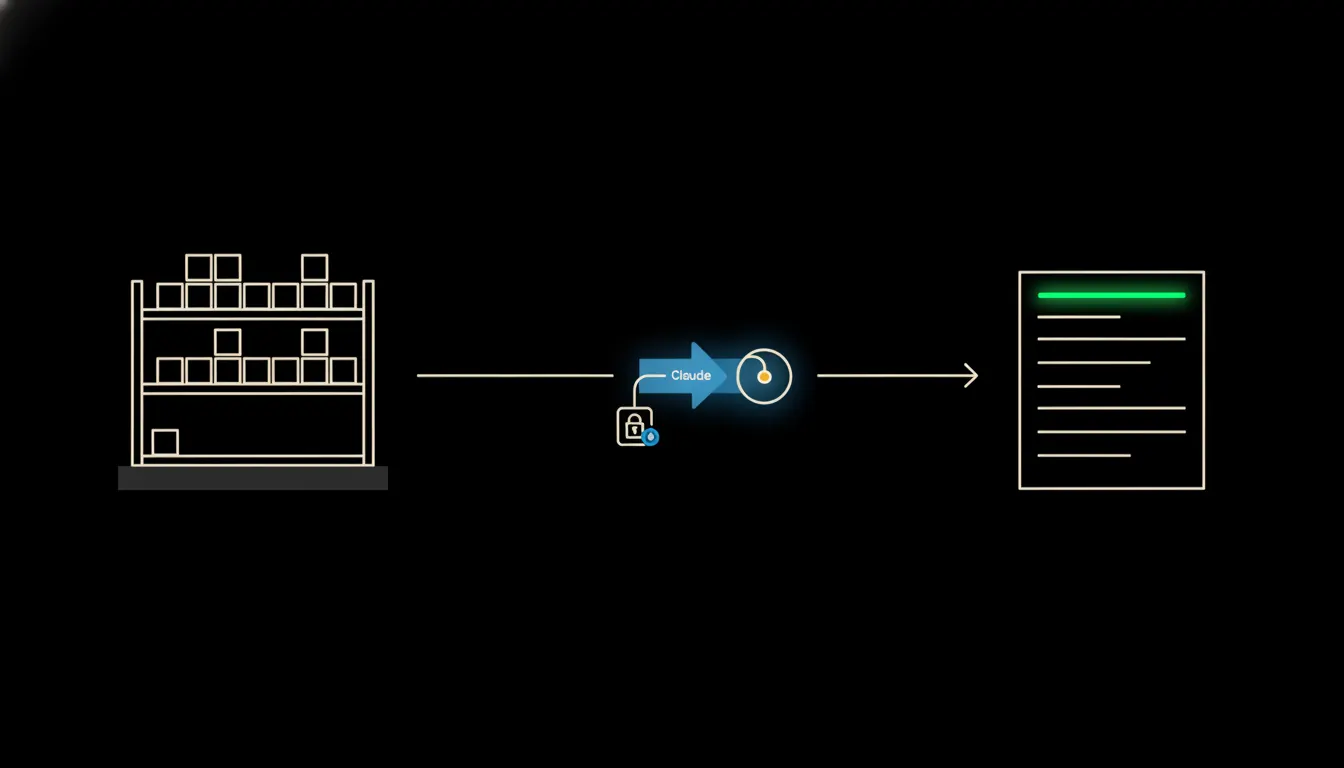
The cancellation arrives in the morning. The customer ordered yesterday, but the item is gone: those were the last units and nobody noticed. The shop owner finds out from a complaint, not from the warehouse. The data showing what was running low was there all along.
The work nobody wants to do
Every morning, someone is supposed to check stock levels. Open the system, review movements, compare against minimums, note what is below the threshold. With dozens of SKUs that takes fifteen minutes. With hundreds, it simply does not happen, or it happens once a week.
The result is predictable. A critical item drops to zero on Wednesday. An alert arrives (if at all) on Friday, when the supplier is closed. Customers wait, or they move on. Research among retailers suggests that nearly half of shoppers who encounter an out-of-stock item buy from a competitor next time.
I got a system alert that stock was running low. Timestamp: three days ago.
— Warehouse debrief, abridged
What connecting stock data to Claude actually means
The connection runs through an MCP server: a small, focused bridge between Claude and the system the business already uses for its warehouse. Claude gains access to stock movements, current levels and sales history. That access is identity-scoped: Claude sees exactly what a logged-in warehouse manager or buyer would see, nothing more.
Claude then reviews the data regularly (or on request), identifies items declining faster than usual, compares remaining stock against average daily consumption, and produces a prioritised summary. The output is not a bare alert reading "SKU 4821 below minimum." It is a message: "At the current sales rate this item has roughly five days of stock. Your supplier's lead time is seven days. Responsible person: Jana."
Concretely: connecting to Pohoda
Pohoda (Stormware) is the most widely used warehouse and accounting system for small and mid-sized businesses in the Czech Republic. More than a third of e-shops on the Shoptet platform use it. An MCP server connects to Pohoda via its XML interface or database API. Pohoda stays where it is; nothing changes inside it. One authorised access point for Claude is added.
- Claude reads current stock levels and movements in real time
- Compares average daily consumption against units remaining
- Accounts for seasonal shifts and active campaigns when that data is available
- Produces a prioritised list of critical items sorted by urgency
- Sends an alert to the responsible person, with context, not just a number
Consider a garden-supplies e-shop. Demand rises sharply in spring. The warehouse team checks stock once a week, and a line of transplanting trowels that normally sells three units a day disappears over a weekend. Claude would notice that the sales pace had jumped to five units a day and would flag it to the responsible person on Thursday, not Monday morning.
What Claude will not do about stock and why that is good
The system does not choose a supplier. It does not send purchase orders. It does not decide whether to replenish an item or pull it from the catalogue. Those decisions require knowing the supplier relationship, current cash flow and assortment strategy: things a person knows and a system does not.
This limit is intentional. The value of the alert lies precisely in arriving on time with context, and then leaving the decision to a person. A system that ordered autonomously would need access to financial limits, pricing and contract terms. That is a different scope of responsibility and a different layer of access. Connecting warehouse data to Claude opens none of that.
What it would take
An MCP server for warehouse data is a one-time integration. It connects to the system the business already has: Pohoda, Money S3, Shoptet or a custom database. It runs on the customer's own infrastructure, not a shared cloud. One tenant, one audit trail, no outside eyes on the data.
This is not a year-long project. Setup typically takes days, followed by testing and handover. The business then has a daily overview that would otherwise require either daily manual work or an expensive analytics solution.
What is left
The model is not the bottleneck. The data in the warehouse has always been there. The bottleneck is the gap between that data and the person who should act on it. Claude bridges that gap, not by deciding instead of the person, but by getting the right information to them at the right moment.
If you want to know what this would look like for your system, write to us. A short call is enough to understand what the business already has and where a connection would make sense.