A customer sends an enquiry on Tuesday morning. The sales rep would love to respond within the hour. But first they need to check stock — which means writing to the warehouse, waiting to see if the warehouse manager is at lunch, and then assembling the quote. The customer gets an answer on Wednesday. Or they have already ordered from someone else.
The work nobody wants to do
Every sales rep knows this rhythm. An enquiry arrives for twenty line items. The rep knows some of the products by heart — but current availability, live pricing, and reservations for other customers are invisible without logging into the system. So an email goes out, or a phone call is made. The warehouse responds when there is a moment. Meanwhile the rep moves on to something else and comes back to the quote hours later.
The problem is not the warehouse or the sales team. The problem is the gap between two systems: inventory data sitting in an ERP and a sales team that needs that data in real time. That gap costs companies deals. Harvard Business Review research found that companies responding to an enquiry within an hour are seven times more likely to reach a decision-maker than those who wait longer.
Customers do not leave because our price is wrong. They leave because our answer arrived a day after the competitor's quote.
— A typical distribution sales director, condensed from three conversations
What connecting actually means
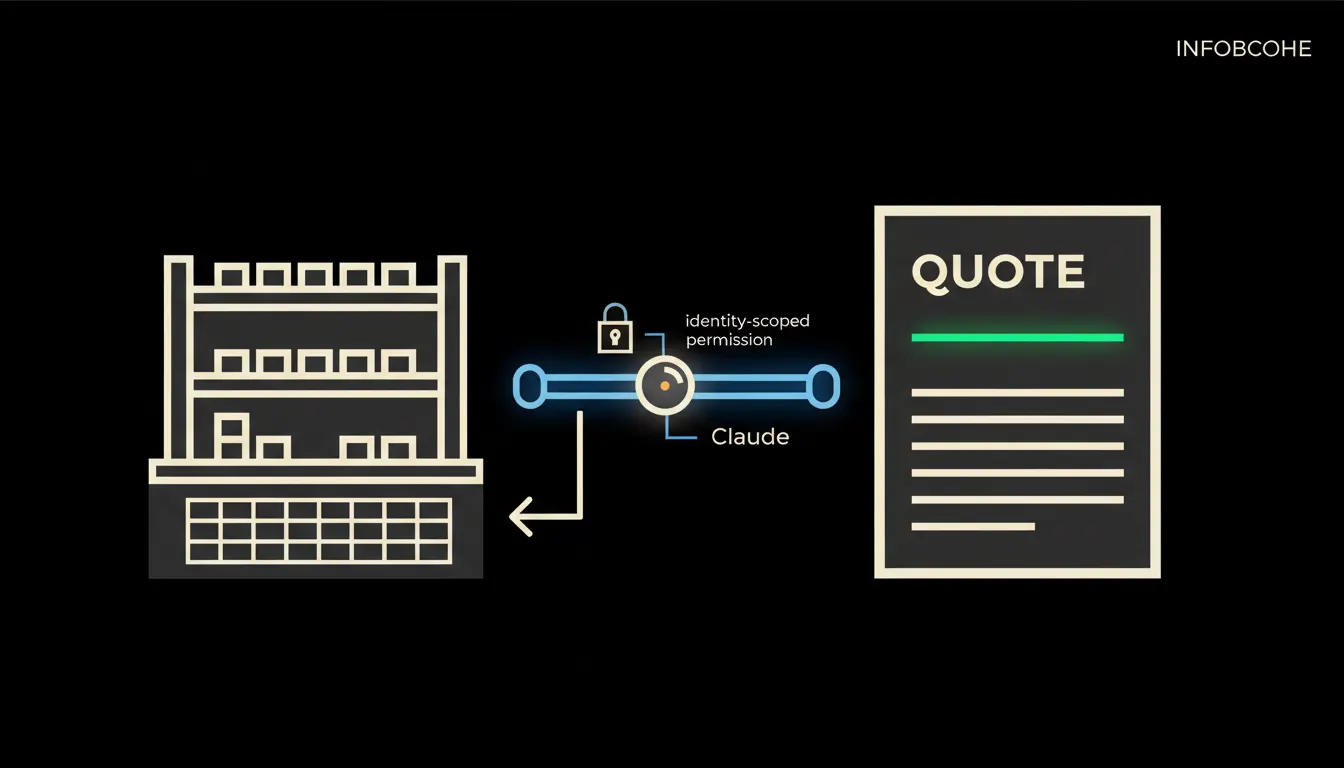
AI stack adds a small MCP server to your existing inventory system — whether that is Pohoda, Helios, FlexiBee, or another ERP. The server does exactly one thing: it bridges the gap between Claude and your inventory database. When a sales rep asks Claude a question, Claude queries your system through the MCP server and responds within seconds.
The critical detail: the MCP server carries the logged-in user's identity. Sales rep Jan sees what Jan is allowed to see — nothing more. Stock reservations for a VIP customer that Jan does not have clearance for stay hidden. No data copy, no Excel export, no new system to maintain. Your ERP stays exactly where it is. Only the bridge is added.
Concretely: Pohoda and the sales team
Pohoda by STORMWARE is the most widely used accounting and inventory system in the Czech Republic — over 130,000 companies run on it. It has a well-defined database structure for items, price lists, reservations, and stock movements. The MCP server we add reads this data in real time and responds to natural-language queries. A sales rep types: "How many of item XY do we have in stock and what is the current price for customer Z?" — and the answer arrives before they can reach for the phone.
- Real-time availability check on a specific item or product group
- Price list lookup for a specific customer or purchasing tier
- Reservation overview — what is already allocated to other orders
- A drafted quote with the correct numbers, ready to paste into the rep's message
- A low-stock alert if the requested quantity is close to the warehouse limit
An illustrative example: a fifteen-person distribution company selling industrial components. Sales reps send five to fifteen quotes per day. Every quote previously meant at least one warehouse query — or repeated VPN logins into Pohoda from the field. After the MCP bridge is in place, reps ask Claude in plain language without launching a VPN or waiting for a colleague. The quote goes out while the customer is still waiting for it.
What AI will not do with quotes — and why that is good
Claude does not send the quote on the rep's behalf. It does not decide on a discount. It does not replace the relationship the rep has built with the customer over years. All of that stays with the person — deliberately. The MCP server is a bridge for data, not for decisions. The rep gets the information instantly, but the final word and the signature on the quote are theirs.
This is precisely why the system is trustworthy. Companies that worry about AI making mistakes are right in one respect: AI without firm boundaries can produce nonsense. An MCP server with a defined identity and access scope holds those boundaries. Claude does not work with stale data or guess at inventory — it reads directly from your system, in real time, with the permissions of a specific person.
What it would take
This is not a year-long project. Your ERP stays exactly as it is — no migration, no new licence, no implementation in five phases. AI stack adds an MCP server that runs on your own infrastructure. One tenant, one audit trail, your data nowhere else. The sales team starts using Claude with their existing permissions — the same way they would log into any other company tool.
What remains
The model is not the bottleneck. Claude can draft a quote — and it does it well. The bottleneck is the gap between Claude and the data your company already holds: price lists, stock levels, reservations, customer terms. That gap exists because no one has yet bridged it in a way that carries your permissions and runs on your infrastructure. That is exactly what we do.
Write to us — a short call is enough to understand which ERP you run and what the MCP server would need to do. Your quote could be on its way before the customer has had time to write to anyone else.