Every company has a price list. Most companies have three. One in the accounting system, one in a spreadsheet on the shared drive, and one the sales rep remembers from the last product briefing. The customer gets whichever version the rep happened to have open.
The work nobody wants to do
The product manager updates prices in the system. Sends an email. Mentions it at the team meeting. The sales rep still downloads the quote template from the shared folder (the one sitting there since spring) and sends a price that stopped being valid six weeks ago.
The error surfaces either at contract signing or (worse) after invoicing. The fix takes hours. The customer relationship takes a hit. And someone in the company starts asking whether it might be time to have "one price list everyone works from." Good idea. Technically straightforward. Rarely followed through.
I knew we had changed the price. But Tomáš still had the old figure in his template. The customer got two different numbers on the same day.
— Sales director, B2B distributor (a situation described from practice)
What it actually means: one source, direct access
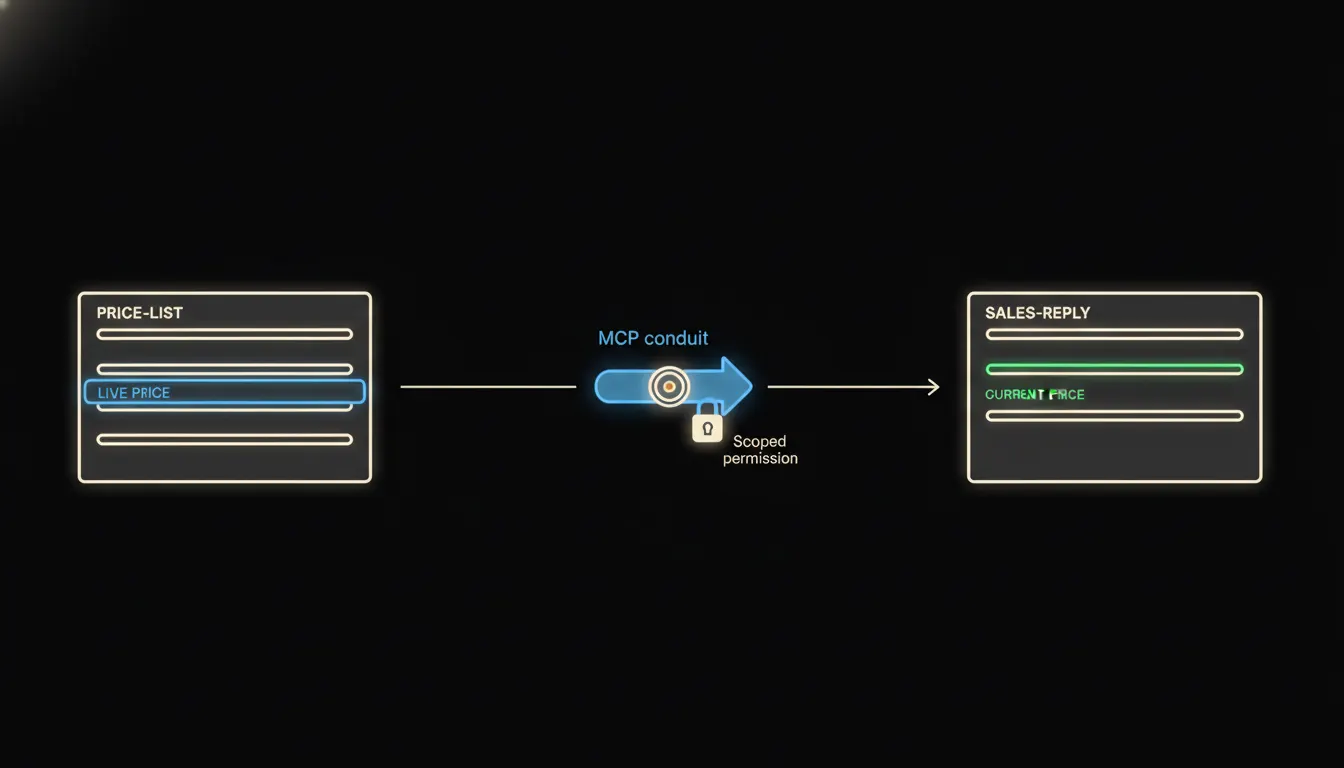
The principle is simple. The price list lives in one place: in an ERP system, in a billing platform, in an internal database, or in an e-shop back-end. An MCP server is a small, focused bridge that lets Claude query that place directly. Not a copy, not an export, not a synchronised spreadsheet. Directly.
The important detail: the MCP server carries your identity. Claude sees exactly what you see: with your permissions, your discount tiers, your conditions. A sales rep and their manager can receive different answers because they hold different access rights. No leakage into data they are not entitled to see. No admin-view without login.
Concretely: Pohoda or Fakturoid as the source of truth
Pohoda by Stormware is one of the most widely used accounting and ERP systems in the Czech Republic. It holds product catalogues, pricing tiers, discount groups, and stock availability. Fakturoid is the go-to billing platform for a large share of Czech freelancers and smaller B2B companies. Price-list items live directly in the invoicing configuration. Neither system is the problem. The problem is that a sales rep cannot reach them mid-conversation with a customer without switching context: open the app, find the item, copy the number, come back. Illustratively, if a sales team handles similar queries dozens of times a day, that adds up to meaningful time lost to context-switching.
- Customer asks for the current price of a product → Claude queries Pohoda or Fakturoid via MCP and returns the live number.
- Sales rep wants to know if an item is in stock → the query goes directly to the inventory record, not to a spreadsheet from last week.
- Customer asks about payment terms for their segment → the MCP server checks their category and returns the conditions applicable to their account.
- A product price changes → no template updates, no email to the sales team. The next query returns the new number automatically.
A smaller e-shop with a B2B section on Shoptet or Upgates may maintain individual price lists for dozens of resellers. Today the rep has to remember who has which agreement, or dig through email. With an MCP server connected to the e-shop admin, Claude asks correctly based on the customer's identity and returns the right number without any guesswork.
What connected pricing will not do and why that's good
Claude with access to the price list does not mean customers receive discounts automatically. Exception conditions, strategic discounts, non-standard payment plans: those are decisions a person approves. The bridge carries data, not authority.
That limit is deliberate. The company keeps control over what it agrees with a customer. Claude helps with what is defined and valid. When something falls outside that scope, it flags it and hands the conversation back to the sales rep. A system designed this way can be trusted precisely because it does not overstep.
What it would take
An MCP server connecting your price list is not a year-long project. It is a focused bridge: written once, running on your own infrastructure, carrying your identity. No data leaves your system. No synchronisation into a third-party cloud. The sales rep asks Claude, Claude asks your system, the current answer comes back.
What's left
The model is not the bottleneck. Claude handles pricing queries, comparisons, and formulations without error. The bottleneck is the gap between Claude and the place where your prices actually live. That gap is what we close.
Write to us. A short call is enough to work out where your price list lives and whether connecting it makes sense. No commitment, no annual contract, no three meetings before anything happens.