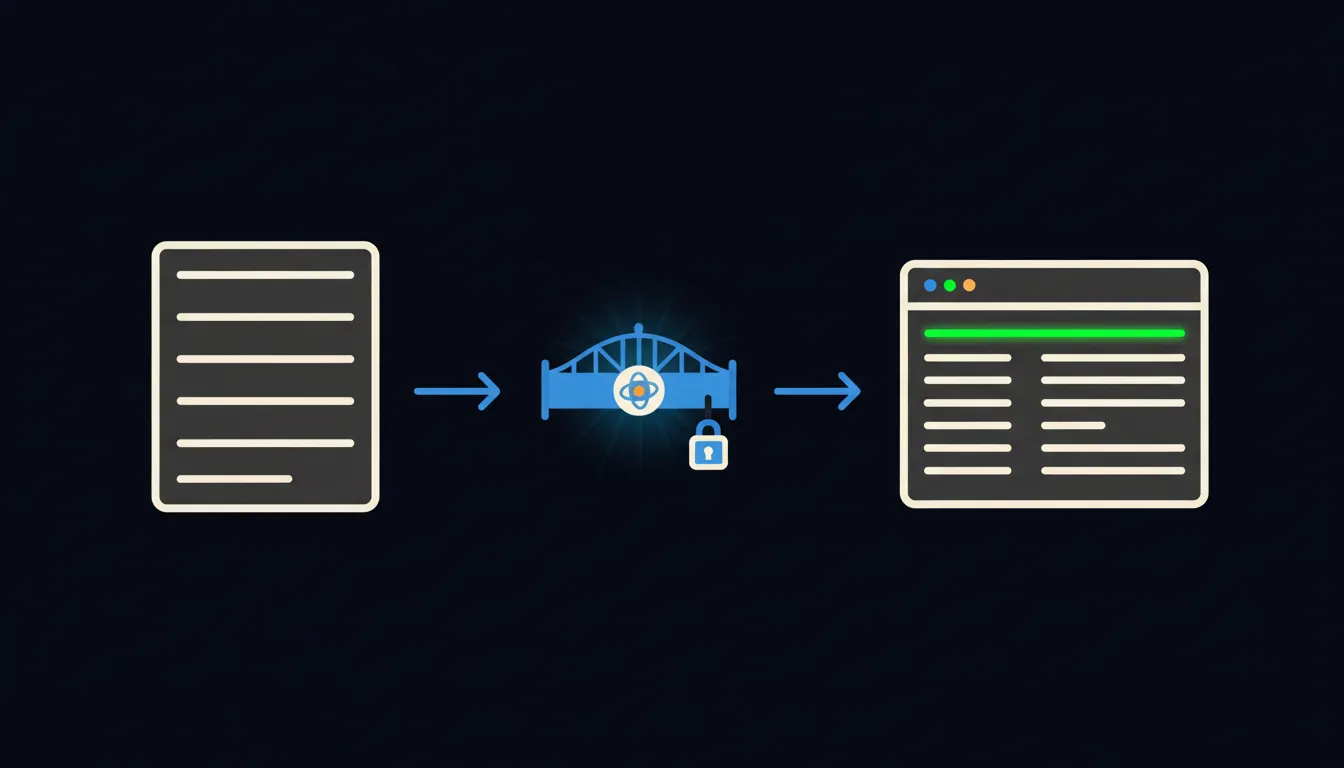
AI for accounting can do a lot. But only in a vacuum. Without access to your Pohoda data, it can only answer in generalities. The connection is the step that turns AI from a demo into a colleague who actually knows your numbers.
The work nobody wants to do
A construction company owner on Monday morning asks: how much do our customers owe us in total, and which invoices are more than 30 days overdue? The answer is in Pohoda. But getting it out takes effort: log in, navigate to the receivables view, apply filters, export to Excel, then calculate.
The whole ritual takes ten, fifteen minutes. It repeats every week. The result is a number that was sitting in the system the whole time. The problem is not Pohoda. The problem is that a few extra clicks stand between you and your own data.
"Everything is in Pohoda, but every time I want a quick overview I spend ten minutes on an export."
— A typical Monday morning at a small Czech company
What connecting actually means
Pohoda has an API interface (mServer). Through it, invoices, receivables, payables, and the customer directory can be read by a machine. An MCP server is a small service that wraps this API and hands it to Claude: with your identity, with your permissions, without copying data to a third-party cloud.
The result: you write to Claude "which companies owe us more than 50,000 CZK and are overdue?" and it queries Pohoda on your behalf. It returns specific company names, amounts, and days overdue. Pohoda remains your system. The MCP server is just the relay.
Concretely: what a Pohoda bridge handles
Pohoda is used by more than 130,000 companies in the Czech Republic. Most of them have years of data in the system: invoices, suppliers, customers, payment history. That is exactly the kind of material Claude is good for. Not for making decisions, but for getting oriented quickly.
- Overdue receivables with specific company names and amounts
- Summary of payables to suppliers with due dates
- Largest customers by revenue over a chosen period (month, quarter, year)
- Cash flow query: income minus expenses over the last four weeks
- Quick check: did payment arrive from company XY for invoice number ZZZ?
An accountant at a small firm, or an owner who manages Pohoda themselves, can handle all of these queries in plain natural language. No exports, no filtering, no Excel. Illustratively: if this kind of orientation currently takes around ten minutes a day, that adds up to over forty hours a year that come back to actual work.
What AI for accounting will not do, and why that is a good thing
The MCP server for Pohoda is read-only by default. Claude does not pay invoices, approve expenses, or write records. If you want write operations, that is an explicit choice requiring additional confirmation. This constraint is intentional.
The decision "do we pay now or wait for the incoming payment from a client" is a business judgment call. Claude gives you the information to make that decision. It does not make it for you. Trust in the system comes from knowing exactly where its limits are.
What it would take
Pohoda mServer needs to be running and accessible on your company network (or server). The MCP server is installed on the same infrastructure. Configuration covers your Pohoda credentials and the list of operations Claude is permitted to perform. The whole setup is an afternoon, not a multi-month project.
What this comes down to
The model is not the bottleneck. Claude handles accounting data well. The bottleneck is the gap between it and the data already sitting in your Pohoda. The MCP server closes that gap.
If you want to know what connecting Pohoda would look like for your company specifically, write to us. A short call is enough to figure out what makes sense and what does not.