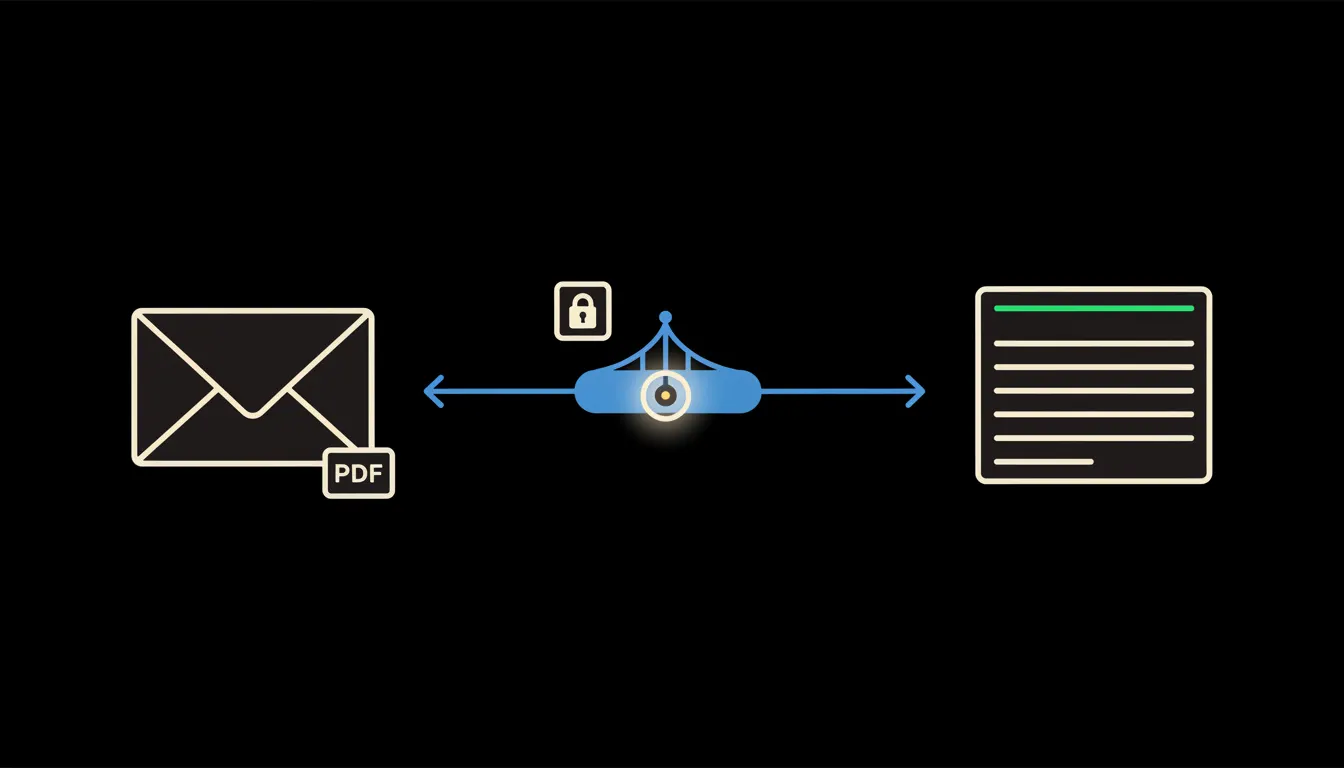
Every business with suppliers knows the feeling: ten PDFs sitting in the inbox, the bookkeeper is out, and one invoice with a three-day payment deadline needs to be in the system right now. Meanwhile, you are trying to do something else entirely. Processing invoices is not complicated work, but it cannot be deferred, and it reliably interrupts everything.
The work nobody wants
A supplier invoice arrives as a PDF. Someone has to open it, read it, check the supplier registration number, copy out the amount, due date and payment reference, then enter the whole thing into the accounting system as a new record. One invoice takes five minutes. Twenty invoices on a Monday morning is an hour of work that demands concentration and cannot afford a mistake.
A wrong payment reference means the transfer arrives at the wrong recipient. A missed due date means a late-payment fee or a damaged supplier relationship. And all of it is mechanical: read a structured field from a PDF, type it into a box in the system. That is precisely what Claude does reliably.
Four invoices came in while I was at lunch. All of them waiting for my approval in the system.
— Owner of a 12-person construction firm (illustrative scene)
What this actually means
The core is straightforward: one small MCP server with access to the company inbox and the accounting system, operating strictly under the identity of the person who processes invoices. Claude sees no more than that person would see when logged into the same systems. It does not read other inboxes, write to other companies, or share data with anyone.
When a new email arrives with a PDF attachment, Claude reads it, recognises it as an invoice, extracts the key fields (supplier, net amount, VAT, total, invoice date, due date, payment reference, invoice number) and creates a draft incoming record in the accounting system. A draft, not a posted entry. Approval and payment are yours.
Concretely: Pohoda and your company inbox
Pohoda is the de-facto standard for small and mid-sized Czech businesses, and it has an XML API and mServer interface that allow records to be created programmatically. A firm receiving eighty invoices a month spends an estimated two to four hours a week on re-entry alone. Those are hours that move from routine to anything more useful.
- Claude reads the PDF attachment from an incoming email or a downloaded data-box attachment.
- It structures the fields: supplier (registration number, name), net amount, VAT amount, total, due date, payment reference, invoice number.
- It checks the supplier against the Pohoda supplier directory. If known, it matches automatically.
- It creates a draft incoming record in Pohoda with status "pending approval", not "posted".
- It sends you (or your bookkeeper) a summary: what arrived, what was matched, what needs manual review.
For a freelance bookkeeper managing accounts for five small firms at once, this can mean that instead of entering raw PDFs, she receives prepared drafts and focuses only on review and exceptions. Work that made sense to do manually when there was no other option now exists only because firms have not yet taken that one step.
What Claude will not do with invoices and why that's right
Claude will not decide whether the invoice matches goods or services actually delivered. It will not post a record without your knowledge. It will not make a payment. It will not match an invoice to a purchase order unless you give it explicit access and rules for that. These limits are not technical constraints; they are deliberate.
An invoice for a delivery that never happened, or for a different amount than agreed: those are situations where a person must decide. The bridge behaves like a careful assistant, not an auditor. The more precisely the boundaries are defined, the more you can trust what it does within them.
What it would take
No year-long project, no accounting migration. The MCP server gets access to your company inbox and your accounting system under your identity, and it runs on your infrastructure, not a shared cloud. Invoice data does not leave your environment. The audit trail is yours.
What's left
The model is not the bottleneck. Claude reads and structures invoices; it does that reliably. The bottleneck is the gap between the incoming email and the accounting system. That gap exists because no one has closed it yet. There is no technical reason why, in 2026, a person should still be manually re-typing numbers from a PDF into form fields.
Write to us. A short call is enough to understand how many invoices you receive each month, what your inbox looks like, and whether you use Pohoda or another system. From there we can tell you exactly what the MCP server needs and give you a realistic estimate of what it would save.