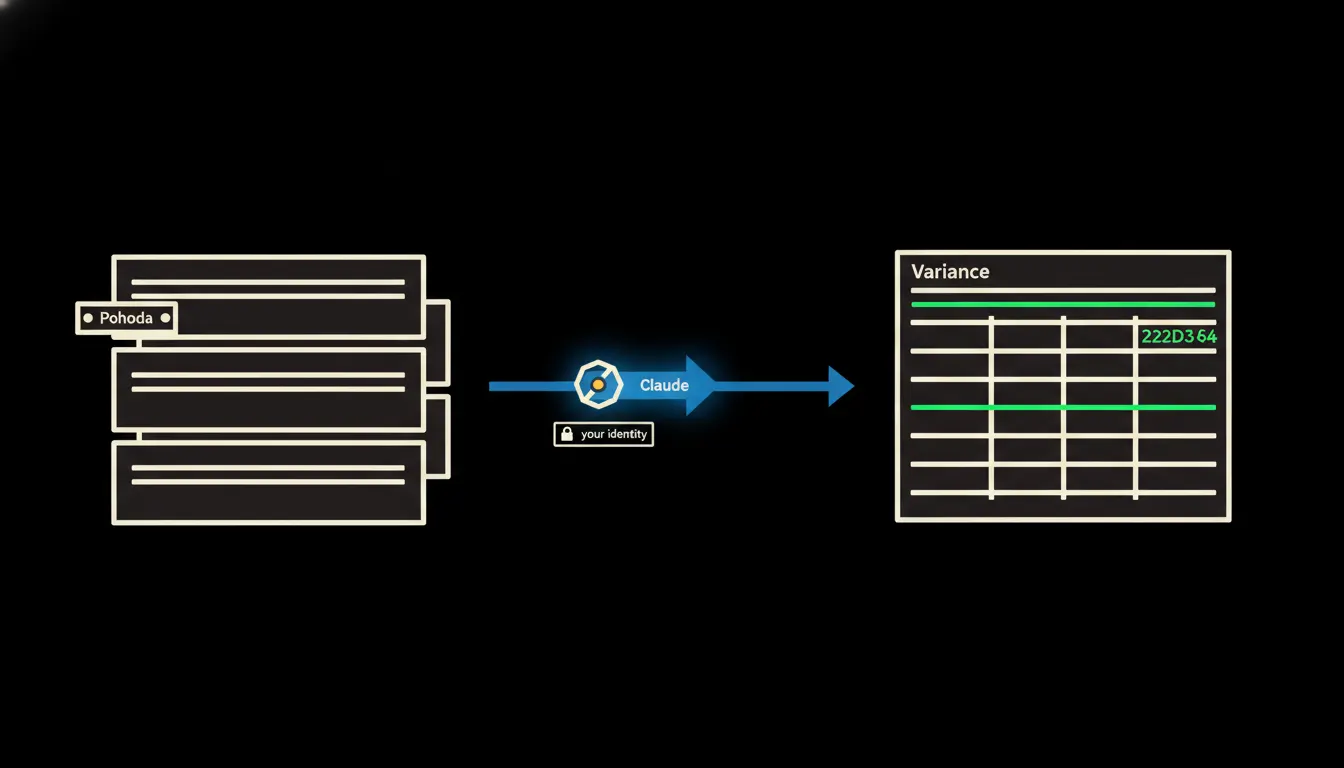
Every small company knows the moment: a quarterly review, someone asks how spending is tracking against plan, and the finance manager says they'll look into it and follow up. The answer arrives a day or two later, after an export from the accounting system, a copy-paste into Excel, and a pivot table that nobody else in the room can read. The model is not the bottleneck. The gap between the question and the data the company already has: that is the bottleneck.
The work nobody wants
Pohoda holds all the data. Every invoice, every cost centre, every payment: it's all there, structured and stored. The problem is getting a specific answer out: "Which categories have exceeded budget, and by how much?"
Getting that answer requires an export. Then line-matching. Then variance calculations. Then a chart, so it looks presentable. The whole ritual takes an hour for a routine report, three hours for an ad-hoc question about an unusual category. And it repeats every month, sometimes every week. A large share of what we call "financial reporting" is actually moving data from one format to another.
Monthly close, abbreviated: half a day of exports, a quarter-day of spreadsheets, a quarter-day of actual analysis.
— Typical month-end at a small company
What connecting your accounting system to Claude actually means
A single MCP server connects to Pohoda (or Fakturoid, or ABRA Flexi) under the credentials of a specific user. Claude can then answer financial questions directly, the same way an accountant with a terminal in front of them would. No data copy is moved anywhere. No export. No Excel as an intermediary.
The key property: the bridge carries the user's identity. Claude sees exactly what the finance manager sees after logging into Pohoda, no more, no less. If the manager doesn't have access to payroll data, neither does Claude. Permissions are not bypassable and are not shared across the whole company; every query runs under the user's own login.
Concretely: Pohoda and the typical query loop
A company running Pohoda has invoices, cost-centre expenses, bank movements, and order records all in the system. With a connected MCP server, the finance manager can ask: "What are our total marketing costs this quarter compared to plan?" And Claude responds in approximately thirty seconds. Illustratively: a five-person team that previously spent three hours preparing a monthly report might receive the same answer on demand, whenever a question arises.
- Variance query on a specific cost category: Claude pulls current data directly from Pohoda.
- Comparison across multiple cost centres at once: no need to download and merge several exports.
- Six-month trend in a single category: Claude builds the summary from the transaction record.
- Identification of invoices that exceed the monthly budget cap, as an automatic signal before month-end close.
Consider a freelancer or small e-shop with four employees: the bookkeeping is handled by an external accountant and the owner relies on whatever the accountant sends each month. With Claude connected, the owner can check spending status themselves this afternoon, without waiting, without emailing the accountant, without taking up her time on a routine question.
What AI reporting will not do, and why that's good
Claude will answer "where are we" and "how far off plan are we." It will not answer "what should we do about it", and rightly so. A variance in marketing costs might mean a deliberate over-investment in a promising campaign, or an overlooked error in an order. The context that distinguishes those two situations lives in the finance manager's head, not in the accounting system.
The bridge is intentionally read-only. It does not change data, approve expenses, or send any communications. By doing no more than what is asked, it stays predictable. Predictability is the condition of trust, and trust is the condition for a finance manager to use this tool at all.
What it would take
Connecting Pohoda to Claude is not a year-long project. It is one MCP server, deployed on the company's own infrastructure, configured with the credentials of specific users. No data leaves your cloud. No vendor has access to your accounting system. The audit trail runs through your own environment: every query, every response.
What remains
The model is not what's slow. The data is in Pohoda. The budget is in a spreadsheet. The question is clear. What's slow is the gap between what lives in the system and what reaches the person making decisions. That gap is what we close.
If you'd like to understand what connecting your accounting system to Claude would mean for your company specifically, write to us. A short call, no preparation required. We bring examples; you bring questions.