Every company has lived through it. A new person joins — smart, motivated — and spends the first two weeks walking around the office asking about things that are written down somewhere, only nobody knows where. HR explains it on Monday, again on Wednesday, a third time on Friday. The manager stops mid-task to walk through how timesheets work. The colleague next door breathes a quiet sigh of relief when the new hire finally figures out where the stationery is. It is not that new employees ask bad questions. It is that the company has no way to put its knowledge exactly where it is needed at the moment it is needed.
The work nobody wants to repeat
Global research is consistent: knowledge workers spend roughly a fifth of their working week searching for information that should already be available. For an HR generalist in a small company, every new hire brings dozens of recurring questions — about leave, timesheets, internal processes, who to ask about what. Many of those questions can be answered immediately if you know where to look. The problem is that the documents are scattered: part in Google Drive, part in email, part in the head of the person who has worked there for ten years.
The result is a paradox. The company already has the knowledge — the onboarding manual exists, the processes are documented, the templates are in a shared folder. But the new hire does not know that, does not have time to browse through it, and finds it easier to ask a real person. That real person then becomes a navigator instead of doing their own work. Knowledge is trapped in a format that requires a human guide to unlock it.
"Where do I find the overtime timesheet template?" The answer is three folders deep in Drive, named 'HR_forms_final_v2_revised.xlsx'. Everyone learns that — after the first month.
— A scene from onboarding, first Wednesday
What connecting documents to Claude actually means
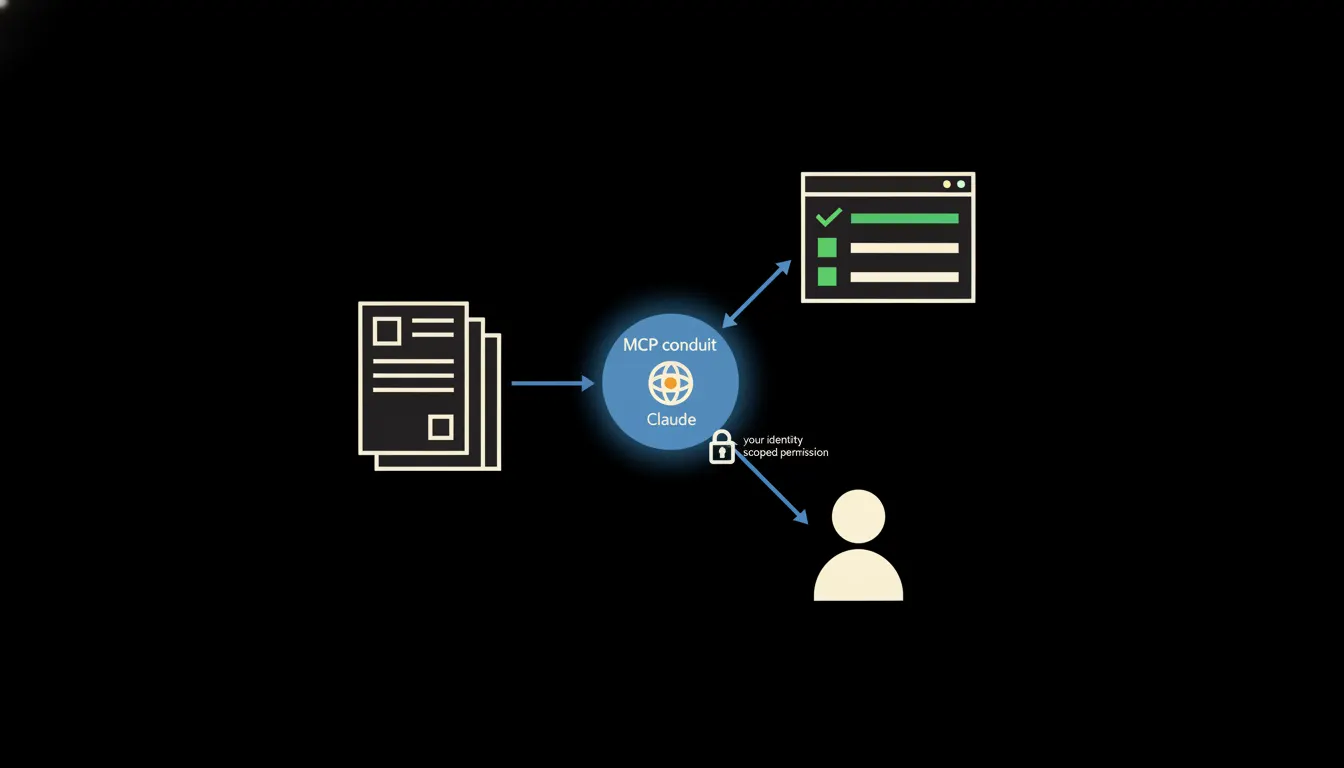
AI stack builds small, focused MCP servers — bridges between Claude and the systems a company already runs. For onboarding, it works like this: Claude is given access to internal documents, the onboarding guide, wiki pages, and process descriptions — but only through the identity of the specific employee asking. Claude never sees more than the employee would see if they were browsing the folders themselves. Sensitive documents they do not have access to remain out of reach.
The new hire then asks Claude instead of HR or the manager. And Claude answers — not from guesswork, but by citing the current document. If the answer is not in the documentation, Claude says so and indicates who to ask. No hallucinated internal policies. No invented rules. Only what the company has actually written down.
Concretely: Google Drive, shared folders, and the onboarding handbook
Most Czech companies keep onboarding materials somewhere in Google Drive or SharePoint. The documents exist — the onboarding plan, a benefits overview, an internal glossary of abbreviations, the procedure for reporting sick leave, the health and safety registration form. The problem is not missing content; it is the content being unreachable at the moment it is needed. An MCP server connects Claude to this storage: searchable, respecting access rights, without copying data anywhere else. When the company updates a document, Claude reads the new version on the next query — not a stale copy from memory.
- New hire asks how to submit a leave request → Claude cites the relevant section from the current internal guide and links the correct form.
- Employee does not know who approves travel expenses → Claude finds the responsible person from the organisational structure they have access to.
- Someone is looking for the weekly reporting template → Claude returns a direct link to the current file version in Drive.
- Question about sick days → Claude answers from the current version of the employment policy, not the 2021 version a colleague vaguely remembers.
An illustrative example: a software company with forty employees where HR is handled by one person alongside payroll and recruitment. Each new hire brought an estimated eight to ten questions per week in the first month. After launching the onboarding guide, recurring questions shifted to Claude — HR was left with exceptions, approvals, and conversations that genuinely required human judgement.
What Claude as a guide will not do — and why that is a good thing
Claude will not decide who gets assigned to a project. It will not approve an exception to company policy. It will not conduct a career conversation. It will not hire anyone and will not let anyone go. These things remain with the manager and HR — not because AI lacks sufficient "capability," but because these decisions inherently require context, accountability, and human judgement that cannot be delegated to a system connected to documents.
That is precisely what makes this model reliable. Claude operates within a clearly bounded space: it answers what the company has documented, within the limits of what the employee is allowed to see. The moment a question steps outside that space, Claude names who to contact — and stops. It does not start improvising. An onboarding guide that stays within its competence is a guide that can be trusted.
What it would take
This is not a year-long project. The company does not need to change where it stores documents. The MCP server connects to the existing Google Drive or SharePoint — using the permissions employees already have. The onboarding skill is saved to the skills library as a company standard: set up once, shared with every subsequent new hire, updatable whenever a process changes. The infrastructure runs on the company's own cloud, not on a third-party server. Data does not leave the company perimeter.
What remains
The model is not the bottleneck. Claude can handle hundreds of onboarding questions. The bottleneck is the gap between Claude and the documents the company has stored in folders that take a new hire over an hour to navigate. That is the gap we close.
Write to us — a short call is enough to work out whether and how quickly this makes sense for your setup. HR stops repeating itself. The new hire stops being afraid to ask. And the person who used to know all the processes by heart can finally focus on the work that genuinely requires their judgement.