Tracking contract deadlines is nobody’s job in a small company. That works fine until a lease or a service agreement slips past its notice period and renews for another twelve months. Then it is a budget line nobody approved, and a decision the calendar made for you.
The work nobody wants
Contracts live in five places at once. A PDF in the shared Drive folder, a scan in someone’s inbox, the signed original in a binder, an amendment attached to a message, and a spreadsheet that someone started two years ago and stopped updating after six months. Each of those places is right about something different.
The notice period is never in the same spot and never in the same shape. Three months before the agreed term ends in one contract, the last day of the calendar quarter in another, six months for an open-ended lease of business premises under Czech civil law. To know when you have to speak up, you have to work it out. By hand. Contract by contract. And then remember it eight months in advance.
We found out on Tuesday. It renewed on Sunday.
— Next year’s budget, abridged
What connected actually means
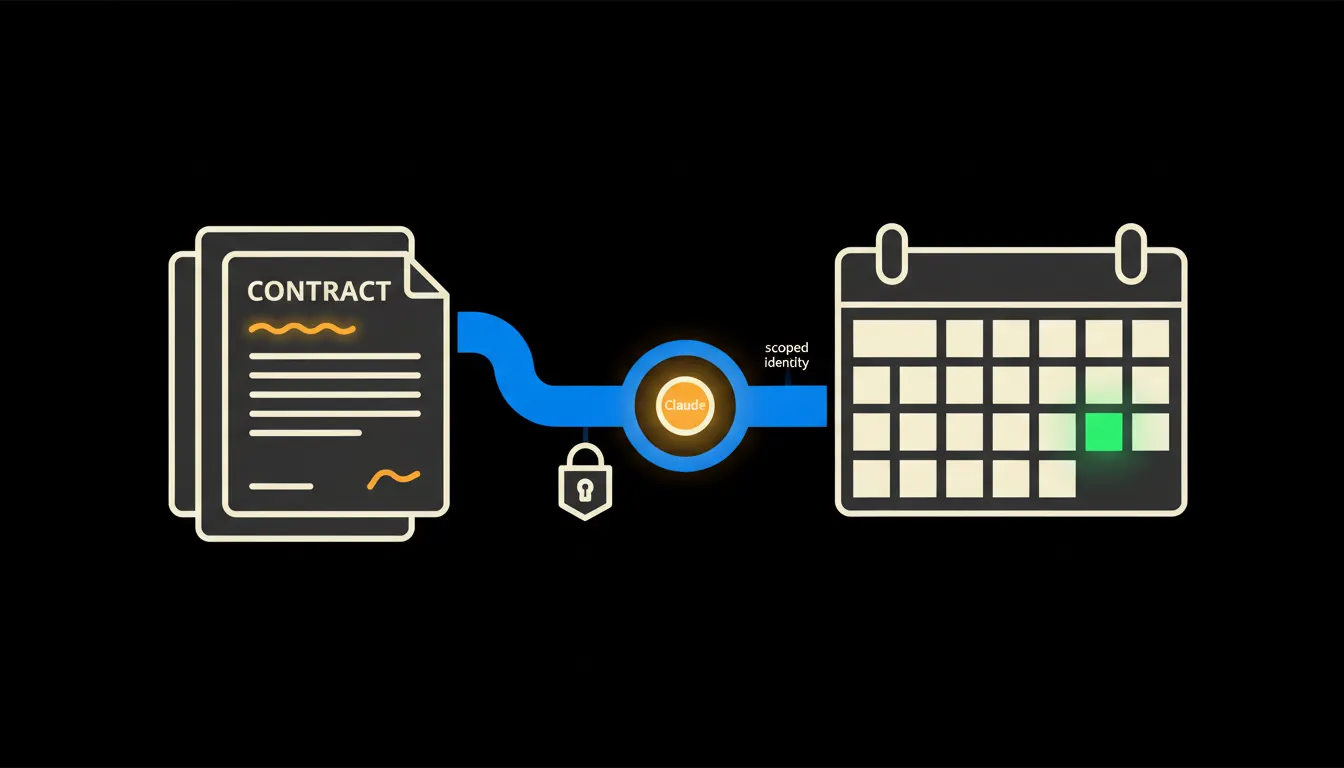
A model that can read a contract surprises nobody now. The missing piece sits elsewhere: the model cannot reach your folder. That is what we build. A small MCP server is a bridge between Claude and one specific system you already run, here the contract folder and the company calendar.
The bridge carries your identity. Claude asks in your name and with your permissions, so it sees exactly the contracts you would open yourself. Nothing is copied out, nothing is indexed into a vendor cache. Only what the question needs gets read, on your infrastructure, with an audit trail.
Concretely: the contract folder and the company calendar
Nothing moves. The contracts stay where they are, in Google Drive or SharePoint, in the structure people are used to. Only the bridge is added. Illustratively: a company with thirty to fifty live contracts usually has two or three deadlines per quarter, and not one of them is visible anywhere.
- Finds the clauses on term, notice and automatic renewal, including the amendment that quietly changed the original period.
- Works out the real date by which notice has to reach the other side, not the date the contract ends.
- Creates a calendar alert with whatever lead time you set, typically several weeks before the deadline.
- Adds what the contract is, who owns it internally, and what the supplier costs per year according to accounting.
- Flags contracts where the wording is ambiguous instead of inventing a date.
An illustrative example: the operations lead of a fifteen-person agency asks on Monday morning what runs out in the next ninety days and what it costs. The answer comes back as five items with dates and a pointer to the exact paragraph in the exact PDF. A review that used to take an afternoon with binders now takes as long as reading the list.
What deadline tracking will not do, and why that is good
Claude does not serve notice. It does not write to the other side, does not send anything, and does not decide whether a supplier is any good. Negotiating the price, choosing to stay, and signing stay where they belong, with a person. Where the wording is genuinely contested, the reading belongs to a lawyer, and the bridge should say so out loud.
That limit is exactly why the system is worth trusting. Its output is not an action you have to audit afterwards, it is time to decide. When the bridge is unsure about a date, it marks the contract as unclear. Uncertainty reported plainly is more useful than a precise number someone made up.
What it would take
This is not a year-long programme and you are not buying a new contract management product. The bridge connects the folder you already keep to the calendar you already check every morning. It runs on your infrastructure, in your tenant, under your identity. A first version usually covers one folder and one calendar, and everything else gets added once it is clear what is worth flagging.
What is left
The model is not the bottleneck. The bottleneck is the distance between it and the data your company already has. With contracts that distance is close to absurd: the deadline exists, it is written in a document you signed yourself, it just never meets the calendar. That is the gap we close.
If you want to see what such a bridge would look like over your own contract folder, write to us. A short call is usually enough to work out where the contracts sit and which deadline is worth watching first.