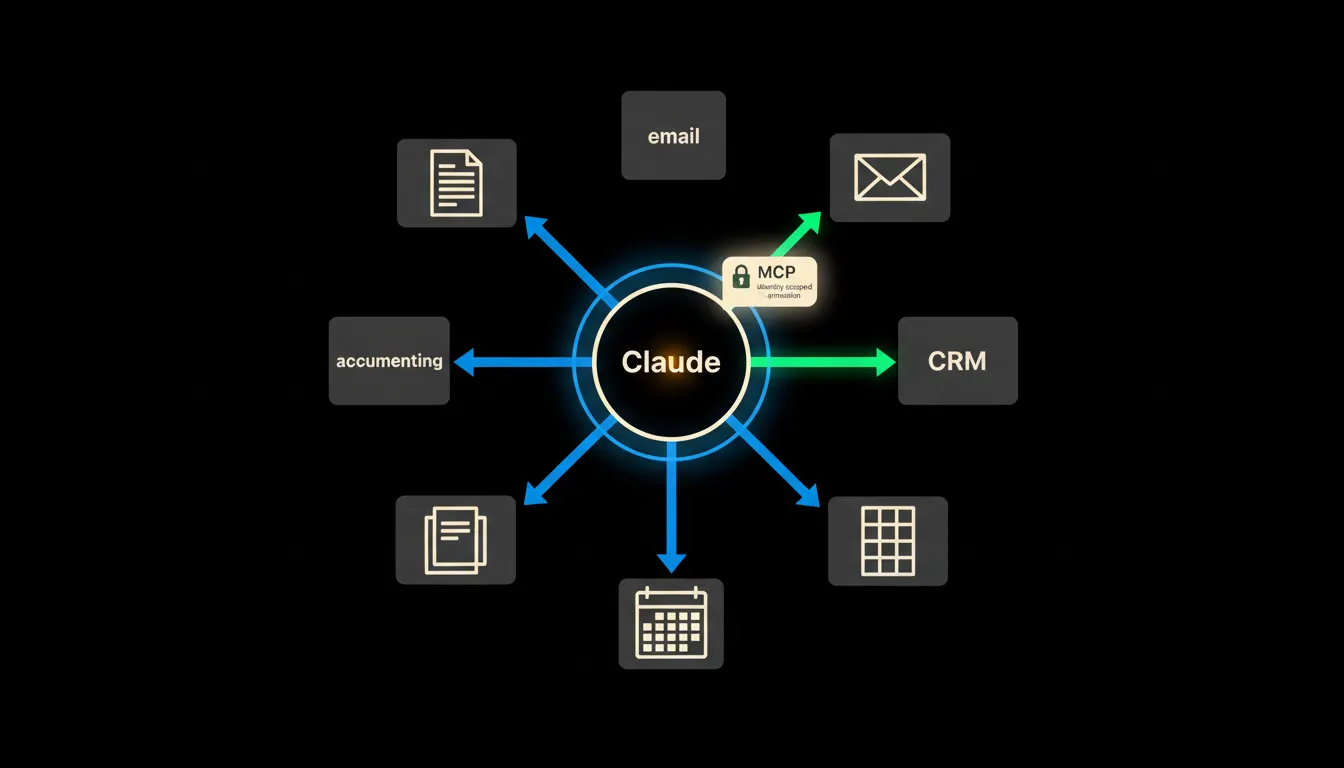
Company data and AI is the question almost every small-to-mid business CEO is working through right now. Most of them have tried Claude or a similar assistant. And most ran into the same wall: the assistant knows nothing about their company. It cannot see invoices, does not know their customers, has no access to last year's proposals. A clever stranger, not a company colleague.
The work that repeats every day and nobody enjoys
A sales manager needs a briefing before a key customer meeting. They open the CRM, check the latest invoices in Pohoda, scan through a month of email, and read the internal notes in Google Drive. Forty minutes. The meeting is twenty.
The same pattern repeats when preparing a proposal, during the monthly report, during a new hire's onboarding. The data exists. It is inside the company. But it is fragmented across five systems that do not talk to each other. And an AI assistant without access to any of them is just a glorified text editor.
We have everything written down, every meeting, every invoice. But by the time I pull it all together, it feels pointless to be paying for AI that can't do it either.
— Owner of a trading company, 18 employees, ahead of a connection demo
What connecting your data to AI actually means
Connection does not mean copying your company data somewhere into the cloud and pointing AI at it. It means Claude gets the ability to query the systems your company already runs, at the moment a user asks a question, using that user's own identity, not an admin account with access to everything.
The mechanism is an MCP server: a small, focused connector sitting between Claude and a specific system. A Fakturoid MCP server can answer the question "What does Novak s.r.o. owe us?" by querying Fakturoid with the same permissions the user already has. Claude does not get a full database export. It gets an answer to a specific question.
Concretely: where to start and why there
The order of integration determines whether results arrive in three weeks or in a year. The fastest return comes from systems used most frequently, with data that is naturally textual. That is email and calendar. Every employee opens them dozens of times a day. The context density is highest. And the technical connection is simplest.
- Email and calendar first: Claude sees the communication history with a customer, prepares a meeting brief, drafts a reply to a complaint in the tone of previous emails.
- Shared documents as the second step: Google Drive or SharePoint hold proposals, contracts, internal manuals. Claude pulls an answer to a customer question or summarises contract terms.
- Accounting or CRM as the third layer: Pohoda or Fakturoid add financial context. A CRM adds the sales history. Only here does asking for overviews and trends make real sense.
- Internal databases and custom systems as the fourth step: warehouses, production, helpdesk tickets. Integration is more involved here, but the value is also highest.
An illustrative example: a small Czech trading company with 15 employees connects company Gmail and Google Drive first. Within two weeks, the sales team uses Claude to prepare proposals and summarise communication. Fakturoid is added in week three. A month after launch, roughly one hour of admin work per employee per day is gone.
What connecting your data to AI will not do, and why that is a good thing
Claude does not make decisions from connected data. It does not sign a proposal, approve an invoice, or set a project price. It prepares the brief, summarises the history, drafts the text. The final step belongs to a person.
This limit is not a technical shortcoming. It is intentional. Companies that understood this early are building Claude as a colleague who processes information and prepares recommendations, not an automation that runs the business. The result is faster work by people who know what they are doing, not a replacement for those people.
What it takes in practice
Connection does not require a year-long implementation or an internal IT team. An MCP server for Gmail or Google Drive is ready in days. It runs on the company's own infrastructure, not ours. Data does not leave the company environment. Access rights are the same as in the original system.
Where to start tomorrow morning
The model is not the problem. Claude is ready and capable the moment you give it the data your company works with every day. The problem is the gap between the model and the systems your company actually runs. That gap is what we close.
Write to us. A short call is enough to figure out where in your company to start and which connection will return results the fastest.