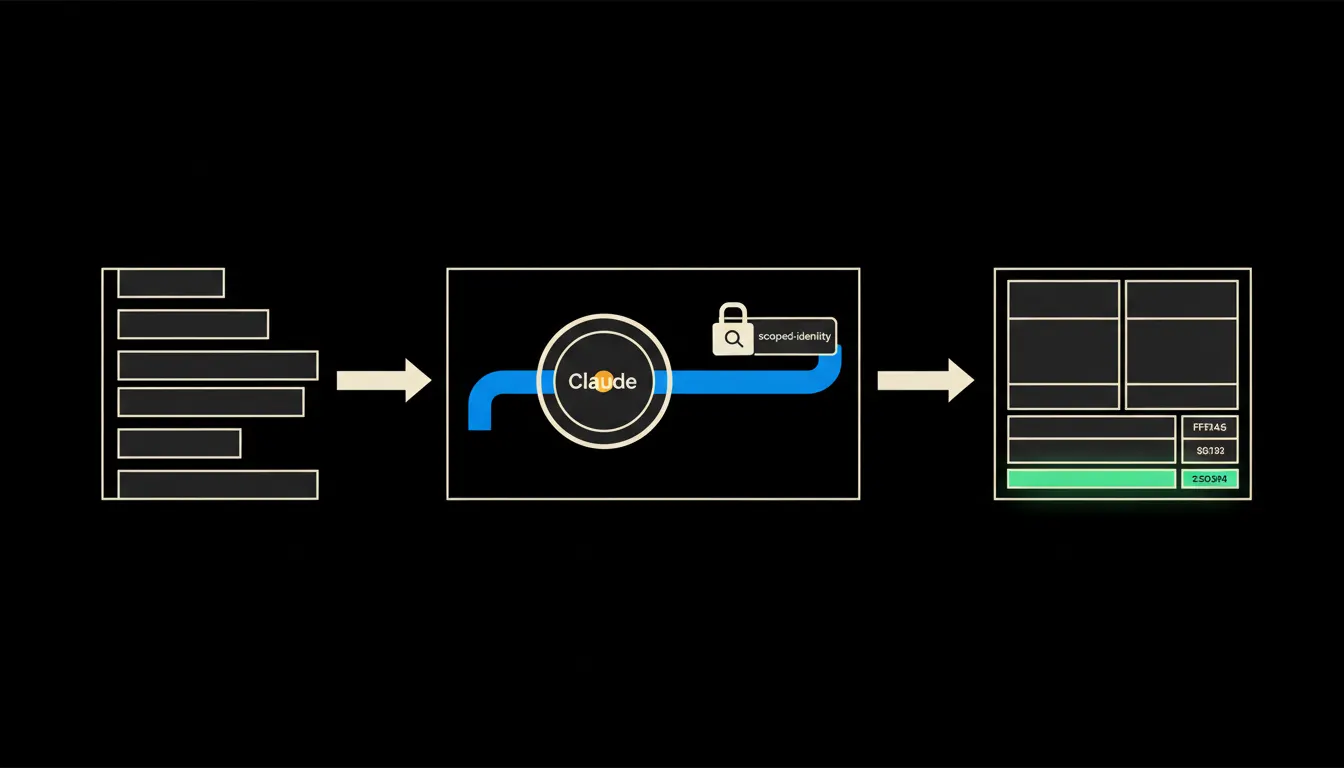
How much does a company AI assistant cost? The usual answer is a three page proposal with a number nobody can defend. In practice the price has four components and only one of them has a public list price. The other three decide whether you end up with something people open every morning, or a subscription nobody looks at after the first month.
Why nobody gives you a single number
The model price list is public. Anthropic publishes per-user monthly plans for individuals and teams, and the enterprise tier is quoted case by case. If all you want is to give people access to Claude, the budget takes ten minutes: headcount times the monthly rate times twelve, plus API usage, which is billed per token and can be estimated in advance.
That is not the question an owner is actually asking. When a CEO asks what a company AI assistant costs, they mean an assistant that knows their jobs, their invoices, their customers. At that point the price stops being a line on a price list and becomes a question of how many systems the assistant has to open, and with whose permissions.
I do not need the licence price. I need to know what it costs for the thing to know what is in our accounting.
— A budget meeting, abridged
The price has four components
Take any proposal apart and it always breaks into the same four things. Vendors differ only in which one they print in bold and which one they bury.
- The model licence. A per-person monthly rate, publicly listed, the one line you can price on day one.
- Bridges to your systems. One small MCP server for each system Claude has to read: accounting, CRM, drive, mail. A one-off build plus maintenance.
- Identity and permissions. Making sure every person sees exactly what they see in the source system. Without it nothing goes live, because nobody will approve it.
- Written-down procedures. Your own instructions for repeated work, stored once and available to the whole team under their own permissions.
The first line is predictable. The second grows with the number of systems, not the number of people, which surprises most companies. The third is done once and then applies to every bridge after it. The fourth is the only one you can meter: start with a single procedure and add more once you can see where the hours actually go.
Concretely: Pohoda, a CRM and Drive
Take an ordinary Czech company with twenty people. Accounting in Pohoda, sales in a CRM, contracts and quotes on Google Drive, mail and calendar in the same suite. That is four sources. It is not four projects, it is four bridges, each small and each with one job. The systems stay where they are and nothing gets migrated.
- Reads an invoice out of accounting, including what is paid and what is overdue.
- Finds the customer history and the last quote sent in the CRM.
- Opens the contract on Drive that this particular person is allowed to open.
- Returns the answer with a link to the source record, so it can be checked in ten seconds.
Say the operations director of a small construction firm wants a Monday overview: what was invoiced, what has not been paid, and which jobs are drifting away from their budget. Today that is three exports and a call to the bookkeeper. With one bridge to accounting and one to spreadsheets it is a single question. Treat this as an illustration rather than a case study, but it is exactly the kind of work the hours disappear into.
What the price does not buy, and why that is good
You do not get an assistant that sends the invoice, signs the contract or rewrites a price in the catalogue. Reading and writing are two different permissions, and writing is enabled separately, for a specific step and a specific role. Claude drafts, a person approves.
That boundary is the reason the thing can go into production at all. If the assistant could do anything it liked inside accounting, the budget would need a line item for anxiety. Instead the record is simple: who asked, what they asked, what they were allowed to see. One tenant, one audit trail, on your own infrastructure.
What it would take
It does not start with an annual budget. It starts with an hour on a call, listing the systems the company actually uses and ranking them by how much time leaks out of them. Then one bridge gets built, the dullest and most frequent one. It runs on your infrastructure, in your tenant, under your permissions. If it does not pay for itself you switch it off, and you will know exactly why.
What's left
The model is not the bottleneck. You can read the price list in a minute and for most companies the gap between plans is smaller than one monthly invoice. The bottleneck is the distance between Claude and the data your company has been collecting for years in systems the model has never seen. That distance is what we close, and that distance is what can actually be priced.
Write to us. A short call is enough for us to walk through your systems and say which bridge is worth building first, what it involves and what it costs. No three page proposal.