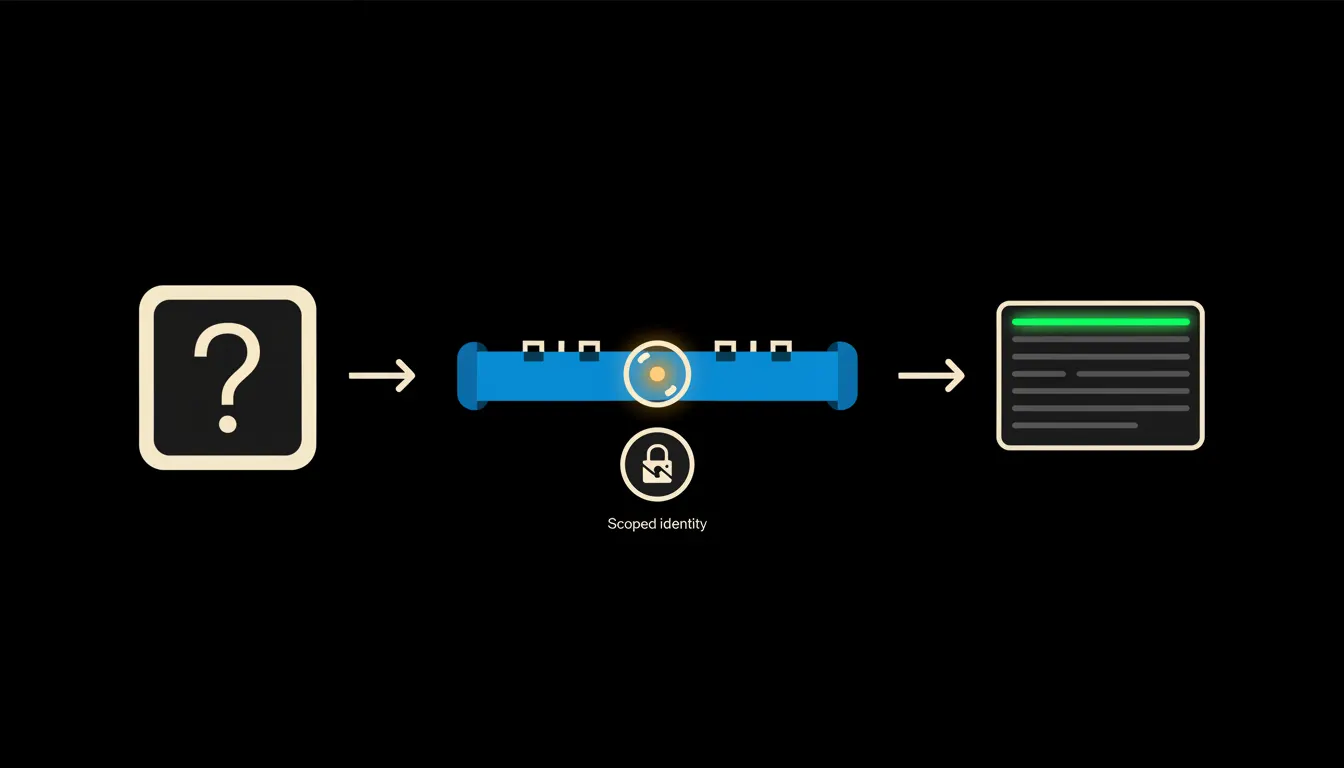
The most common reaction to the letters MCP is a request: show me an example. Fine. Here is one entirely ordinary question from a finance desk, “who is past due and by how long”, walked through step by step. From the moment somebody types it to the moment there is an answer and a record of where it came from.
The work nobody wants to do twice
The question looks harmless. In practice it means opening the accounting system, filtering unpaid documents, comparing them against bank movements because some are already paid and merely unmatched, chasing an email for the disputed ones, and turning all of that into something readable. Done once a month at closing, it costs half a morning.
It gets worse when somebody asks on a Thursday afternoon because a materials order is on the table. Then it is half a morning nobody has. Most companies settle it by producing the overview once a month and estimating the rest of the time. The estimate is usually close. The trouble starts when close is not enough.
Seven open windows and one spreadsheet nobody wants to build a second time.
— A month-end close, abridged
What an MCP server is once you drop the acronym
MCP (Model Context Protocol) is an open standard Anthropic published at the end of 2024. It describes how a model and a system shake hands: what the system offers, how it should be called, what comes back. An MCP server is a small program that sits next to your data and offers Claude a short list of named actions.
It behaves more like a reception desk than a key to the building. Claude cannot “search the accounting system”. It can call the four specific things listed at the desk: list invoices, invoice detail, bank movements, client contact. Ask for anything else and nothing happens, because no such action exists.
Step by step: what happens between question and answer
It takes seconds and at first glance it looks like a trick. Take it apart and it looks like a dull, well documented sequence. That is exactly the state you want around company data.
- The accountant writes the question in her own words. No syntax, no table names.
- Claude reads the list of tools the server offers and picks the one that fits: unpaid documents as of today.
- The server checks who is asking and sends the query to the accounting system in that person's name, with her rights.
- Rows come back, only the ones she is entitled to. Claude matches them against bank movements, sorts by age and writes the answer, including a note about what it could not verify.
- The log records which tool ran, with which parameters, under whose identity and when. The answer can be traced back to its source.
Picture a four person studio that invoices in Pohoda and keeps its payments with one bank. Today the receivables position gets checked because the owner sits down with it on Sunday evening. With one MCP server over the accounting system it shrinks to a question at eleven on Thursday: who is more than thirty days past due, what does it add up to, and whose balance has been growing for three months. The example is illustrative, the work is real.
What an MCP server will not do, and why that is good
It does not send reminders on its own. It does not reply to clients. It does not move due dates and it changes nothing in the accounting system until we deliberately give it such a tool, and when we do, that tool asks a person to confirm. The server knows a finite list of actions and that list does not quietly grow. The limit is the point.
The second thing it will not do is keep a copy of your data somewhere on the side. The data stays where it lives, the server runs on your own infrastructure and reads at the moment of the question. No index that goes stale, no store you have to audit a year later to work out who can see into it.
What it would take
The first server over a single system is usually a matter of days, not quarters. We sit down for an hour, list the three to five questions that keep coming up in your company, and the tools the server needs fall out of that list. It runs on your infrastructure, signs in with your accounts, keeps a record of what it did. When a sixth question appears, a sixth tool gets added.
What is left
The model is not the bottleneck. Claude can take that receivables question apart without difficulty. The bottleneck is the distance between the model and the accounting system where those numbers sit. A bigger model does not close that distance. One small server with a finite list of actions and your identity does.
Write to us. A short call is enough to list the questions that keep repeating in your company and to work out which system makes sense to connect first.