The question is always the same: who on the team has an active eSIM right now, how much data is left on it, and what next week's trips will need. The answer exists. It is just split between confirmation emails from Airalo, a spreadsheet someone keeps out of goodwill, and the memory of whoever books the flights.
The work nobody wants
A company with ten people travelling abroad handles this the same way every time. Somebody buys a data package, a confirmation email arrives, the number gets retyped into a spreadsheet. A month later the spreadsheet is wrong, because two profiles have expired, and one colleague bought another one himself and attached it to a trip settlement.
The cost is small, so nobody pushes on it. Price is not the problem. The problem is that nobody finds out in time that someone abroad is running out of data, and at the end of the quarter nobody can say what the company actually spent on connectivity, or on whose behalf.
Three people in Asia, two eSIMs past their expiry, one never topped up. We find out when somebody messages to say there is no signal.
— An operations Monday, abridged
What connected actually means
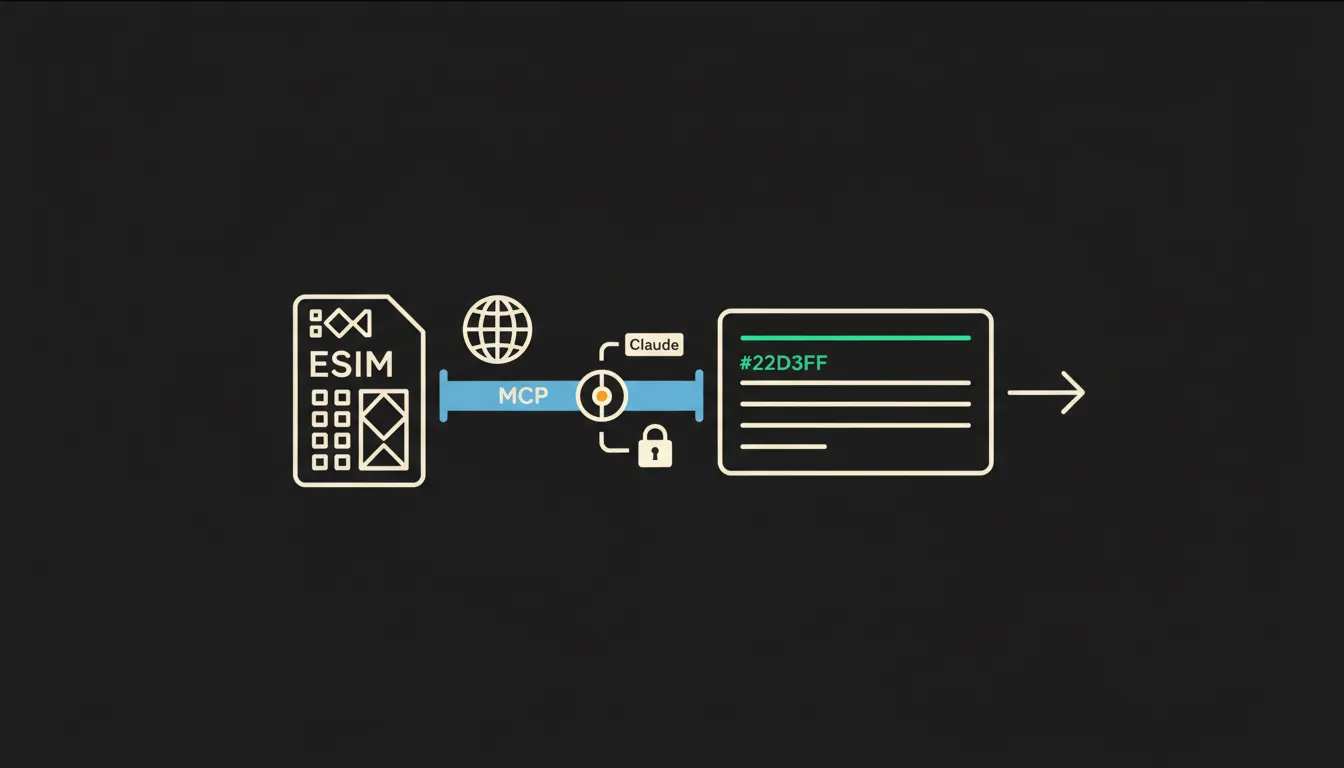
Connecting is not pasting an export into a chat window. It means a small MCP server sits between Claude and the account where the eSIM profiles live. MCP is the open protocol from Anthropic for connecting a model to data and tools. That server does exactly two things: it reads the state of the account, and it returns it as an answer to a question asked in ordinary words.
It carries the identity of the person asking. An operations director sees the whole team, a sales lead sees only their own people, a salesperson sees themselves. No copy is created anywhere. Nothing is exported into an outside memory, nothing is indexed. The server runs on your infrastructure and every query lands in one log.
Concretely: Airalo, the calendar and Pohoda
Nothing you use today goes away. The eSIMs stay in Airalo, the trips stay in the calendar, the receipts stay in Pohoda or Fakturoid. Only the bridge is added. For a company with ten to twenty travellers, that is a handful of queries a day and a few hundred rows of data, a scope that gets built in days rather than months.
- Who holds an active package, until when it is valid, and how much data is left.
- Which trips in the calendar have no connectivity arranged, and which country they go to.
- What the company spent on connectivity abroad last month, and which cost centre it belongs to.
- Which destinations get topped up repeatedly because the first package turns out to be too small.
- A reminder the day before departure when someone still has no eSIM.
Picture a three-person consultancy in Brno that visits clients in Germany and Austria, and flies to the United States twice a year. A team like that could hold the whole picture in one sentence in a chat and stop keeping the spreadsheet altogether. It is an illustration rather than a case study, but the scale of the work is exactly this.
What a connected eSIM view will not do, and why that is good
The bridge does not buy. It will not make a payment, change a plan, or activate a profile for you. It reads the state and prepares the ground. The decision of whether two weeks in Japan needs three gigabytes or ten stays with the person who knows the itinerary. That limit is why a bridge like this can go live immediately.
It also stays out of what it has no business handling. Inside the European Union, roaming is billed at domestic rates and the EU has extended that regime to 2032, so a business trip to Vienna is usually uninteresting in data terms. The trips outside the Union are the interesting ones. A bridge that holds that distinction is more useful than one that reports everything.
What it would take
One company Airalo account, access to the calendar and the ledger, and an hour to settle who is allowed to see what. The bridge runs on your side, under your logins, with your audit trail. This is not a year-long programme. It is one small service that answers one family of questions, and once it proves itself, others get added next to it.
What's left
The model is not the bottleneck. Claude answers a question about eSIMs as well as it answers anything else. The bottleneck is the distance between it and the data your company already holds. That is the distance we close.
If you want to see what this would look like in your company, write to us. A short call is enough for us to say what is worth connecting first, and what you can comfortably leave exactly as it is.